
Restaurants Without Websites Are Losing Orders Right Now
Every night at 7:30 PM, Maria's Kitchen in downtown Sacramento serves some of the best carnitas tacos in the city. The 60-seat Mexican restaurant has a loyal...
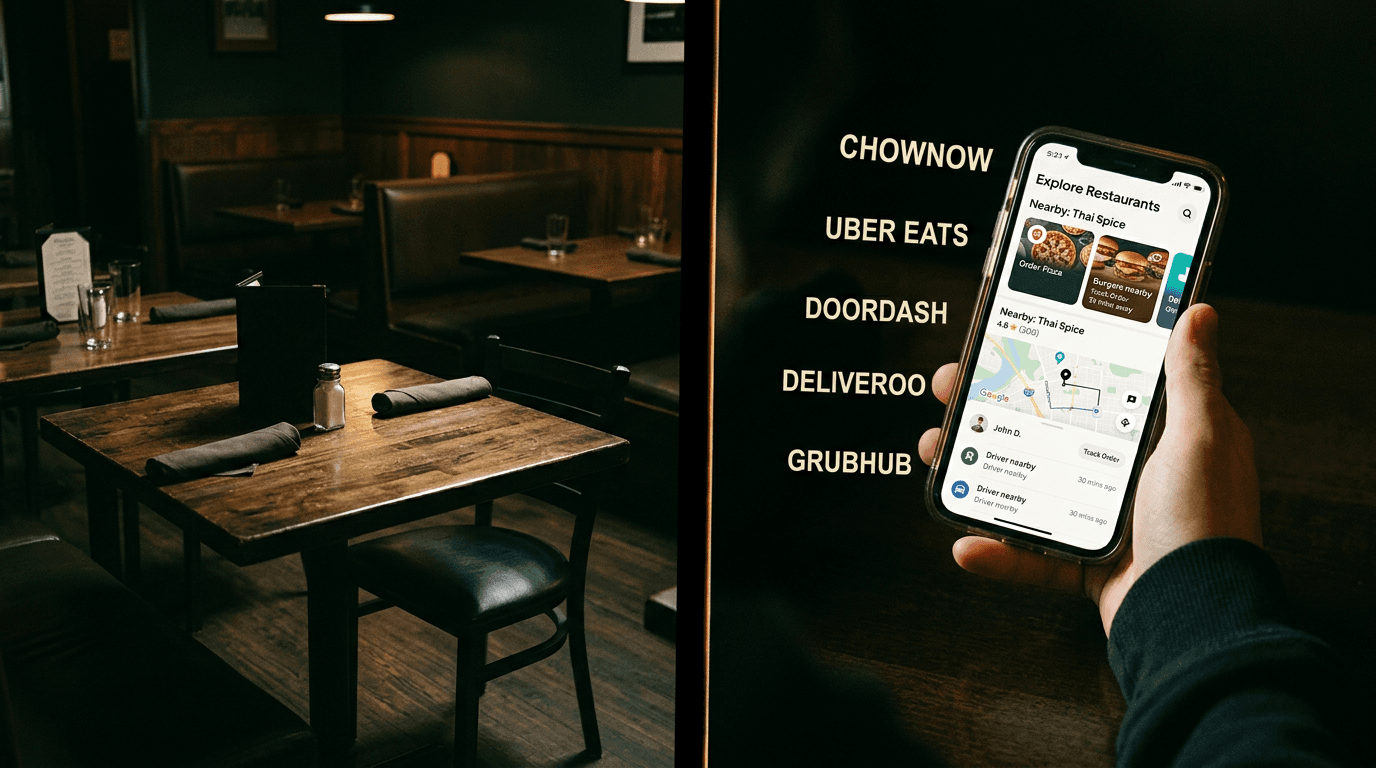
Every night at 7:30 PM, Maria's Kitchen in downtown Sacramento serves some of the best carnitas tacos in the city. The 60-seat Mexican restaurant has a loyal local following, 4.6 stars on Google, and a steady stream of regulars who've been coming for years.
But when Sarah, a marketing manager at a nearby tech company, searches "best Mexican food near me" on her iPhone, Maria's Kitchen doesn't exist. Not in the search results. Not in ChatGPT's recommendations. Not anywhere that matters in 2026.
Maria's entire digital presence consists of a DoorDash listing (her unofficial "homepage"), a Facebook page last updated in November 2024, and a Google Business Profile with no menu link. Meanwhile, El Corazón — a newer restaurant three blocks away with decent but unremarkable food — captures Sarah's $47 dinner order because they have a $29/month website builder for restaurant operations with online ordering.
This scenario plays out thousands of times every day. Research shows that 77% of diners check a restaurant's website before choosing where to eat. Over 50% abandon their search entirely if they can't find basic information like menus, hours, or ordering options.
Maria's Kitchen isn't hypothetical. Roughly 19% of all restaurants operate without functional websites right now. Many of the remaining 81% have sites so broken, outdated, or mobile-unfriendly that they might as well not exist.
What restaurants actually lose without a website
The 77% problem — diners check before they visit
Here's what happens when potential customers can't find your restaurant online: they eat somewhere else.
Recent industry data confirms that 77% of diners verify a restaurant's website before making dining decisions. More than half abandon the search entirely when they encounter missing menus, unclear hours, or broken ordering systems.
Frame this in terms of nightly covers, not percentages. A typical 60-seat restaurant that should be seating 180 covers on a busy Friday night instead serves 90 because half their potential customers couldn't find basic information online.
The commission trap — DoorDash takes 15–30% of every order
Third-party delivery platforms charge brutal commissions. DoorDash, UberEats, and Grubhub extract 15–30% from every order processed through their systems.
Run the math on a restaurant doing $8,000 monthly through third-party apps. They're hemorrhaging $1,200–$2,400 every month in commissions that direct online ordering through their own website could eliminate.
Most restaurant website builders with integrated ordering cost $16–$99 monthly. Even the high-end solutions run less than what restaurants lose to DoorDash in a single week.
The revenue-loss formula (do the math for any restaurant)
Here's a simple formula that calculates what any specific restaurant loses monthly without a proper website:
(Monthly online discoverers) × (Bounce rate without website) × (Average order value) = Monthly missed revenue
Walk through the math for Maria's Kitchen:
- ~900 potential online discoverers per month
- 50% bounce rate when no website exists
- $35 average order value
- Result: $15,750 monthly in missed revenue
Conservative estimates still show thousands lost every month. Even if you cut these numbers in half to account for variables, Maria's Kitchen is leaving $7,875 on the table monthly by not having a functional website.
Missed catering leads — the silent revenue killer
Corporate catering represents high-margin, high-ticket revenue that restaurants without websites never capture. A single office lunch order ranges from $500–$2,000+.
Picture this: An office manager searches "lunch catering near me" on Tuesday morning. El Corazón appears with a dedicated catering page, inquiry form, and downloadable catering menu. Maria's Kitchen shows up as a DoorDash listing with no catering information.
The office manager books El Corazón for a $1,200 order that Maria's Kitchen never knew existed. This happens weekly in every mid-size market across the country.
Bad Google visibility costs you every single day
Google's search algorithm rewards businesses with proper websites containing structured data, consistent NAP (name, address, phone), updated menus, and mobile optimization.
Restaurants without websites rank lower in local pack results and Maps — the exact places where hungry people actually look for dining options. You're fighting Google's algorithm with one hand tied behind your back.
The AI discovery gap — the 2026 problem nobody's talking about
ChatGPT, Google AI Overviews, Google Gemini, Siri, and Alexa now recommend restaurants when people ask "where should I eat tonight?" These AI systems pull recommendations from structured web data — your website, schema markup, and menu pages.
No website means you literally don't exist in the AI recommendation layer. This isn't a future problem brewing for 2027. It's happening right now, in March 2026.
Studies indicate that 67% of Gen Z and Millennials rely on social media and AI-powered tools for restaurant decisions. If AI systems can't find structured information about your restaurant, you've disappeared from the discovery process for two-thirds of younger diners.
"But I have a Facebook page" — why that's not enough
Facebook reach for business pages has collapsed to 2-5% organic reach. Post an update about your weekend specials, and 95% of your followers won't see it.
You don't own Facebook. Algorithm changes happen overnight. Pages get restricted or shadowbanned for mysterious reasons. The platform that 73% of restaurant operators currently use as their primary web presence can disappear tomorrow.
Facebook pages carry almost no SEO value. Search "Mexican food Sacramento" on Google. Facebook pages rarely appear in the results, while restaurant websites dominate the first page.
Instagram follows the same pattern. Great for brand awareness and food photos, terrible as your only web presence. No searchable menu text. No online ordering integration. No structured data that search engines can parse.
Social media should drive traffic TO your website, not replace it entirely.
What a restaurant website actually needs (the minimum viable site)
Building a restaurant website doesn't require a $10,000 custom development project. Focus on essentials that directly impact revenue.
The non-negotiable checklist
Your website needs seven core elements to stop losing orders:
Searchable, text-based menu — Not a PDF. PDFs kill SEO and create horrible mobile experiences. Search engines can't read PDF menus, and potential customers won't zoom and scroll through a tiny PDF on their phones.
Hours and location with embedded Google Map — Make it dead simple for customers to find you and know when you're open. Include holiday hours and temporary closures.
Mobile-first responsive design — Over 70% of restaurant searches happen on mobile devices. Your site must work perfectly on phones first, desktop second.
Online ordering integration — Direct orders through your site, not redirects to third-party platforms. Every order placed through DoorDash or UberEats from your website still triggers their commission fees.
Click-to-call phone number — One tap should dial your restaurant. Sounds obvious, but countless restaurant sites bury contact information or use non-clickable phone numbers.
Reservation or contact form — Capture inquiries for large parties, private events, and catering. Simple contact forms generate thousands in additional revenue monthly.
Fast load time — Under 5 seconds on 3G connections. Slow sites have higher bounce rates, and Google penalizes them in search rankings.
Nice-to-haves that drive more revenue
Once the essentials work properly, add features that capture additional revenue streams:
Dedicated catering inquiry pages convert corporate lunch orders. Email capture systems build customer lists for promotional campaigns. Professional food photography increases average order values. Gift card sales generate immediate cash flow and bring customers back later.
The best website builders for restaurants in 2026
You don't need a developer. You don't need $5,000. You need the right tool that gets you from "no website" to "taking direct orders" fast.
| Website builder for restaurant | Best For | Online Ordering? | Starting Price | Key Limitation | |---------|----------|------------------|----------------|----------------| | Wix | DIY-comfortable owners on tight budgets | Via Square POS add-on | $17/month | Limited restaurant-specific features | | Squarespace | Restaurants prioritizing visual branding | Via third-party integration | $16/month | Requires multiple add-ons for ordering | | Toast | Full-stack POS + website integration | Yes (native) | Custom pricing | Higher cost; locks you into their POS system | | BentoBox | High-end, design-focused restaurants | Yes | $99+/month | Add-ons inflate total cost quickly |
Each platform has specific strengths and weaknesses, but the most important factor is speed of implementation. Every day without a functional website costs money.
The fastest path from "no website" to "taking direct orders" prioritizes simplicity over perfection. A basic site capturing direct orders this week beats a custom site launching in three months.
How to find businesses that need websites (for web pros and freelancers)
If you build websites professionally, restaurants represent the most underserved niche in local business. Here's how to find businesses that need websites systematically.
The 30-minute local restaurant audit
Open Google Maps. Search "restaurants" in your target city or neighborhood. Check 20-30 listings for missing website links. No website link equals immediate prospect.
Cross-reference on Yelp. Search the same geographic area. Look for restaurants with active reviews but no website URL in their business profile.
Check social media. Search restaurant names on Facebook and Instagram. Flag pages with no website links, dead links, or links pointing to defunct sites.
Google restaurant names directly. If no website appears on page one of Google results — only DoorDash listings, Yelp pages, or social media — that's your prospect.
Test existing websites. Many restaurants technically "have" websites that don't work. PDF-only menus, non-mobile-friendly designs, or sites last updated in 2022 are just as problematic as having no site at all.
Score and prioritize. Focus on restaurants that are actively operating (recent reviews), independently owned, and located in markets with sufficient population density to justify web investment.
Where the best prospects hide
Independent, single-location restaurants represent 70% of all restaurants — roughly 152,000+ full-service establishments. These businesses typically lack dedicated marketing staff or IT resources.
Family-owned ethnic cuisine restaurants often have never invested in digital marketing beyond basic social media presence. They rely entirely on word-of-mouth and walk-by traffic.
Mid-size cities show the highest concentration of prospects. Major metropolitan areas have more competition among web developers, while small towns may lack sufficient customer density to justify website investment.
How to pitch a restaurant owner (without being annoying)
Lead with revenue loss, not website features. "You're paying DoorDash $1,800 monthly in commissions. I can build you a site with direct ordering for $99/month."
Show them what their competitor's website accomplishes. Pull up a successful local competitor's site on your phone during the conversation. Demonstrate the catering page, online ordering system, and Google search visibility.
Mention AI discovery gaps. "When someone asks ChatGPT for the best Italian food in [city], your restaurant doesn't appear in the results. A proper website fixes that immediately."
Offer a quick mockup or audit instead of cold pitch decks. Restaurant owners are visual people who appreciate seeing concrete examples over abstract presentations.
The cost of waiting vs. the cost of a website
A functional restaurant website costs $16–$99 monthly. One month of DoorDash commissions on $8,000 in orders costs $1,200–$2,400.
Industry analysis shows that 9% of full-service restaurants face closure risk in 2026. A website won't save a fundamentally broken business model, but it can mean the difference between thriving and struggling for restaurants that customers simply can't find online.
The restaurants that survive the next few years will be the ones that customers can discover, research, and order from easily. Every month spent relying on Facebook pages and DoorDash listings instead of proper websites represents thousands in lost revenue.
For web professionals, restaurants offer a massive, underserved market where the value proposition is crystal clear. You're not selling features — you're selling direct revenue recovery and long-term business survival.
The math is simple. The opportunity is massive. The only question is whether you'll act on it before your competitors do.
Frequently Asked Questions
What's the cheapest website builder for restaurants? Wix starts at $17/month and includes basic restaurant features like menus and contact forms. Squarespace starts at $16/month but requires third-party integrations for online ordering.
How long does it take to build a restaurant website? Using a modern restaurant website builder, you can have a basic site live in 2-4 hours. Getting online ordering set up and testing all features typically takes 1-2 days total.
Can restaurants really lose thousands monthly without a website? Yes. A typical 60-seat restaurant loses $7,000-$15,000 monthly in missed orders, plus catering opportunities that can be worth $500-$2,000 per booking. The revenue loss formula is: (Monthly searchers) × (Bounce rate) × (Average order value).
Do restaurant websites actually help with Google rankings? Absolutely. Google's algorithm favors businesses with proper websites containing structured data, mobile optimization, and updated content. Restaurants without websites rank lower in local search results and Maps.
How do I find restaurants that need websites in my area? Search Google Maps for "restaurants" in your target area. Check 20-30 listings for missing website links. Cross-reference on Yelp and test existing sites for broken functionality. Independent, family-owned restaurants are the best prospects.
Ready to stop losing orders to restaurants with websites? Start with the basics: claim your Google Business Profile, choose a website builder, and get your menu online this week. Or if you're a web professional looking to help restaurants capture more revenue, start your local audit today. Every day of delay costs real money.


