
What a Small Business Website Should Cost (Not What Agencies Charge)
You just got your third website quote this week. $8,000. $12,000. One agency even had the nerve to pitch you $15,000 for what sounds like a basic business site.
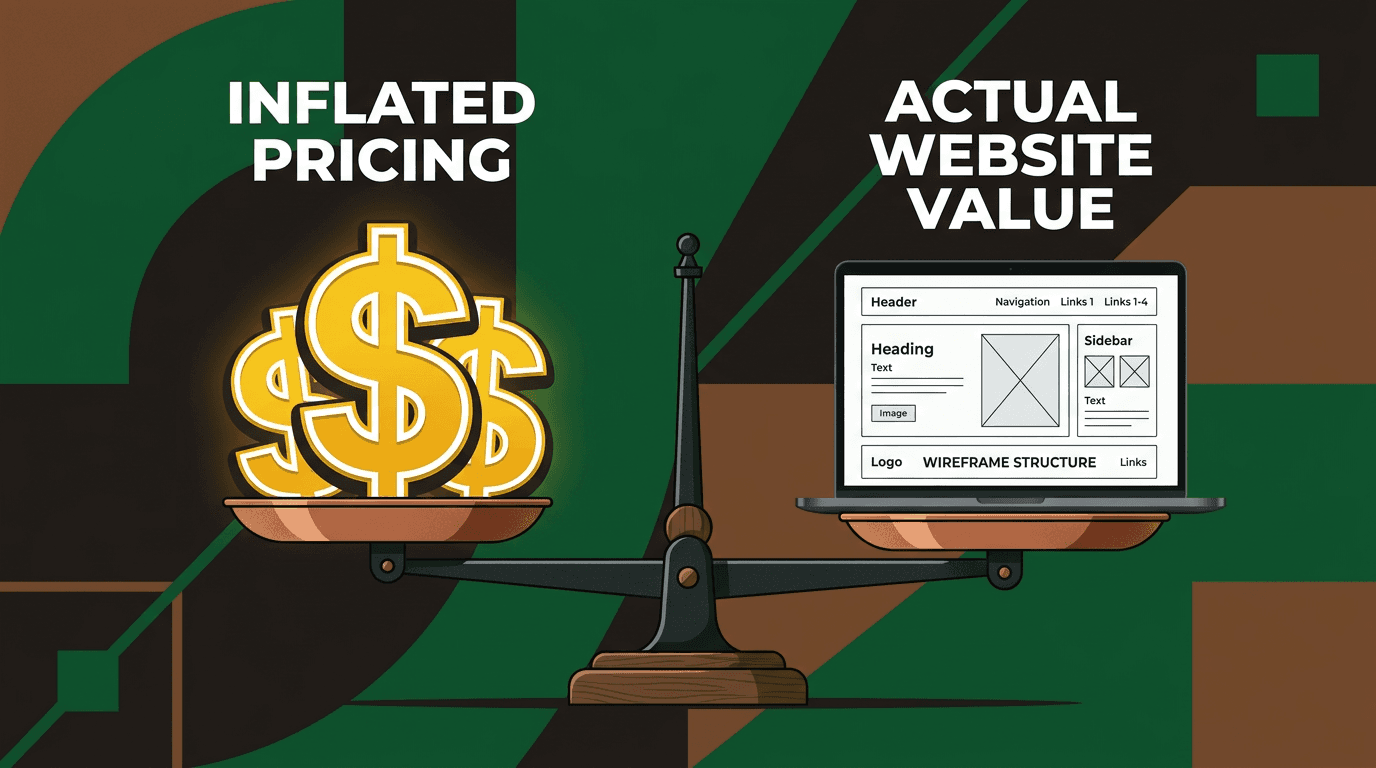
You just got your third website quote this week. $8,000. $12,000. One agency even had the nerve to pitch you $15,000 for what sounds like a basic business site.
Something feels wrong, but you're not sure what fair pricing looks like. You're a smart business owner who can spot inflated costs in most industries, but website pricing seems deliberately opaque.
Here's the truth: the cost for professional website design for a small business typically ranges from $1,500 to $5,000 for a standard 3-7 page site in 2026. One-page sites start around $300, while e-commerce builds run $3,000 to $15,000 depending on complexity.
Most agencies aren't lying to you — they're just charging for a business model you don't need. This article breaks down what websites actually cost to build versus what providers decide to charge, so you can set a realistic budget and avoid overpaying.
Why most website quotes are inflated (and you can feel it)
Your gut instinct is right. Most agency quotes include layers of overhead that have nothing to do with building your site.
Think about the agency sales process you just experienced. You met with an account manager who scheduled you with a project manager who'll coordinate with a designer who hands off to a developer who reports to a QA specialist. Each person needs a salary, benefits, and office space.
You're paying for all of them, even though your small business website needs one skilled person with modern tools and maybe 20-40 hours of focused work.
A competent freelancer or small studio can deliver the same result without the overhead markup. The technical work is identical — domain setup, hosting configuration, template customization or custom design, content integration, and basic SEO optimization.
The difference is business model, not quality.
What actually goes into building a small business website
The core components (every site needs these)
Every professional small business website requires the same foundation:
Domain name costs $10-$20 per year through registrars like Namecheap or Google Domains. Agencies sometimes mark this up to $50-$100, but there's no technical difference.
Hosting runs $5-$50 monthly depending on your needs. Basic shared hosting works fine for most small businesses. Managed WordPress hosting or premium plans make sense once you're getting serious traffic.
Design work varies dramatically based on template versus custom approach. Template-based designs (customized premium themes) take 5-15 hours. Full custom designs take 20-50 hours.
Development time includes setting up the platform, integrating content, configuring plugins or apps, and testing functionality. Budget 10-30 hours for most small business sites.
Content integration means getting your text, images, and contact information properly formatted and optimized. Many clients provide this themselves, but professional copywriting adds $500-$2,000.
SSL certificates are usually free through hosting providers or cost $10-$50 annually if purchased separately.
The "nice to haves" that agencies love to upsell
These additions aren't inherently bad, but they're separate decisions:
Custom illustrations and animations look great but add $1,000-$5,000 to your project without improving conversion rates for most small businesses.
Complex integrations like CRM connections, booking systems, or custom forms require ongoing maintenance. Simple alternatives often work just as well.
Extensive SEO strategy goes beyond basic on-page optimization. Unless you're in a highly competitive market, basic SEO gets you 80% of the benefit at 20% of the cost.
Brand identity and logo design are valuable but separate from website development. Bundling them together inflates the quote and makes it harder to compare pricing.
Real cost ranges by website type (2026 numbers)
One-page website ($300-$1,500)
Perfect for freelancers, consultants, or single-service businesses that need an online presence without complexity.
At $300-$600, you get a clean template-based design with your content, contact information, and basic SEO setup. The site looks professional but uses standard layouts and styling.
At $800-$1,500, you get custom sections, branded colors and fonts, professional copywriting assistance, and mobile optimization testing.
When agencies quote $3,000+ for one-page sites, you're paying for account management and project overhead, not additional value.
Standard small business website — 3 to 7 pages ($1,500-$5,000)
This range covers most local service businesses, consultants, contractors, and professional services.
Your site includes homepage, about page, services or portfolio section, contact page, and optionally a blog or testimonials page.
At $1,500-$2,500, expect template-based design with professional customization, mobile responsiveness, contact forms, Google Maps integration, and basic SEO setup. The designer handles content formatting but you provide the text and images.
At $3,000-$5,000, you get custom design elements, professional photography coordination, copywriting support, advanced contact forms, social media integration, and more detailed SEO optimization.
This is the sweet spot for most small businesses. Anything above $5,000 should include custom functionality or extensive content creation.
E-commerce website ($3,000-$15,000+)
Product-based businesses need shopping carts, payment processing, inventory management, and shipping calculations.
Platform choice affects pricing significantly. Shopify builds typically cost less because the infrastructure exists. Custom WooCommerce or other platforms require more development time.
At $3,000-$6,000, you get a professional template-based store with product pages, shopping cart, payment processing, basic shipping options, and mobile optimization. Perfect for businesses with 10-100 products.
At $8,000-$15,000, you get custom design, advanced filtering and search, inventory management integration, multiple payment options, detailed shipping configurations, and custom functionality.
Above $15,000 makes sense for complex catalogs, custom features, or extensive integrations. For most small businesses, it's overkill.
The DIY route ($0-$500)
Website builders like Squarespace, Wix, or WordPress.com can produce decent results for $10-$50 monthly, plus your time investment.
This works for testing business ideas or very early-stage companies. It often backfires for established businesses because DIY sites frequently look amateur, lack proper SEO optimization, or create conversion problems you don't notice.
The hidden cost is opportunity cost. A professional site that converts 3% instead of 1% pays for itself quickly.
The hidden costs nobody talks about
Your initial website cost is just the beginning. Budget for ongoing expenses:
Maintenance runs $50-$200 monthly if you hire someone, or takes 2-5 hours monthly if you handle it yourself. This includes plugin updates, security monitoring, backups, and troubleshooting.
Content updates depend on your business needs. Simple text changes are easy to learn. New pages, product additions, or design modifications often require professional help at $75-$150 per hour.
Renewals include domain registration, hosting, premium plugins or themes, and security tools. Budget $200-$800 annually.
Email hosting is sometimes separate from web hosting and costs $5-$15 monthly per inbox.
Professional photography isn't technically required, but stock photos scream "generic small business." Budget $500-$2,000 for custom photos.
Future redesigns happen every 3-5 years as design trends change and your business evolves. Plan accordingly.
Total annual cost of ownership typically runs $1,500-$4,000 per year including maintenance, renewals, and updates.
Why the agency quote is $10,000 and the freelancer's is $2,000
Agencies aren't necessarily ripping you off — they're charging for a different service model.
Your $10,000 agency quote includes account management, project management, multiple revision rounds, formal documentation, team meetings, and business insurance. You're buying process and accountability.
The $2,000 freelancer quote covers the same technical work with direct communication and less formal overhead. You get the same website with more personal attention but fewer corporate safeguards.
For most small businesses, a skilled freelancer or small studio delivers better value. You need the end result, not the enterprise-level process.
Red flags in website quotes include vague line items like "strategy development" without clear deliverables, monthly "maintenance" fees that lock you out of your own site, or ownership structures where the provider controls your domain and content.
How to set your website budget (a simple framework)
Start with what you need — not what's being sold
List your actual requirements:
- How many pages do you need?
- Do you sell products online?
- What integrations are truly necessary?
- Can you provide content, or do you need copywriting help?
Match your needs to the pricing ranges above. Most small businesses land in the $1,500-$5,000 range for good reason.
The "revenue rule" for website budgets
Your website should cost a small fraction of the revenue it supports or generates.
If your business generates $100,000 annually and your website drives 30% of your leads, spending $3,000 on a professional site that works 24/7 is an obvious investment.
If you're just starting out, beginning with a $1,500 site and upgrading as you grow makes more sense than betting $10,000 on an unproven business model.
Questions to ask before you sign anything
Do I own the site and domain? You should control both completely. Avoid providers who maintain ownership or charge transfer fees.
What's included in the quoted price? Get specific line items. "Design and development" is too vague.
What does ongoing support cost? Understand both emergency fixes and routine updates.
Can I make basic edits myself? Modern platforms make content updates easy. If you can't edit your own site, you're locked into ongoing fees.
What platform is it built on and why? WordPress, Squarespace, Shopify, and other platforms each have pros and cons. Your provider should explain their choice.
The bottom line — what you should actually budget
| Website Type | Cost Range (2026) | Best For | |---|---|---| | One-Page Site | $300-$1,500 | Freelancers, single-service businesses | | Standard Business Site | $1,500-$5,000 | Local businesses, consultants, contractors | | E-Commerce Site | $3,000-$15,000+ | Product-based small businesses | | DIY Route | $0-$500 | Testing ideas, very early stage |
You don't need to spend $10,000 to get a professional website that converts visitors into customers. Focus on finding a skilled provider who understands your business needs rather than the one with the slickest sales pitch.
The best small business websites solve customer problems clearly and make it easy to take the next step. That's about strategy and execution, not budget size.
Ready to move forward with confidence? You now know what fair pricing looks like and how to avoid overpaying for website overhead you don't need.
Frequently Asked Questions
How much does a basic small business website cost in 2026? A basic 3-7 page small business website typically costs $1,500-$5,000 from a professional freelancer or small studio, including design, development, and basic SEO setup.
What's the cheapest way to get a professional-looking website? Work with a skilled freelancer who uses modern platforms like WordPress or Squarespace. Expect to pay $1,000-$3,000 for professional results without agency overhead.
How much should I budget for website maintenance per year? Plan for $600-$2,400 annually, including hosting renewals, plugin updates, security monitoring, and minor content changes. Higher-end sites or hands-off maintenance plans cost more.
Do I really need to spend $10,000 on a small business website? Almost never. Five-figure pricing makes sense for complex e-commerce sites or custom functionality, but most small businesses get everything they need for $1,500-$5,000.
What hidden costs come with a new website? Ongoing hosting and domain renewals, plugin or theme updates, content modifications, email hosting, professional photography, and eventual redesigns every 3-5 years.


