Your Small Business Site Is Overbuilt (and Overpriced)
Last month, I watched a local plumber pay $11,000 for a website with fourteen pages, a blog section, and a "custom content management system." His customers ...

Last month, I watched a local plumber pay $11,000 for a website with fourteen pages, a blog section, and a "custom content management system." His customers need three things: his phone number, his service area, and proof he won't flood their basement.
That's three pages of work, not fourteen.
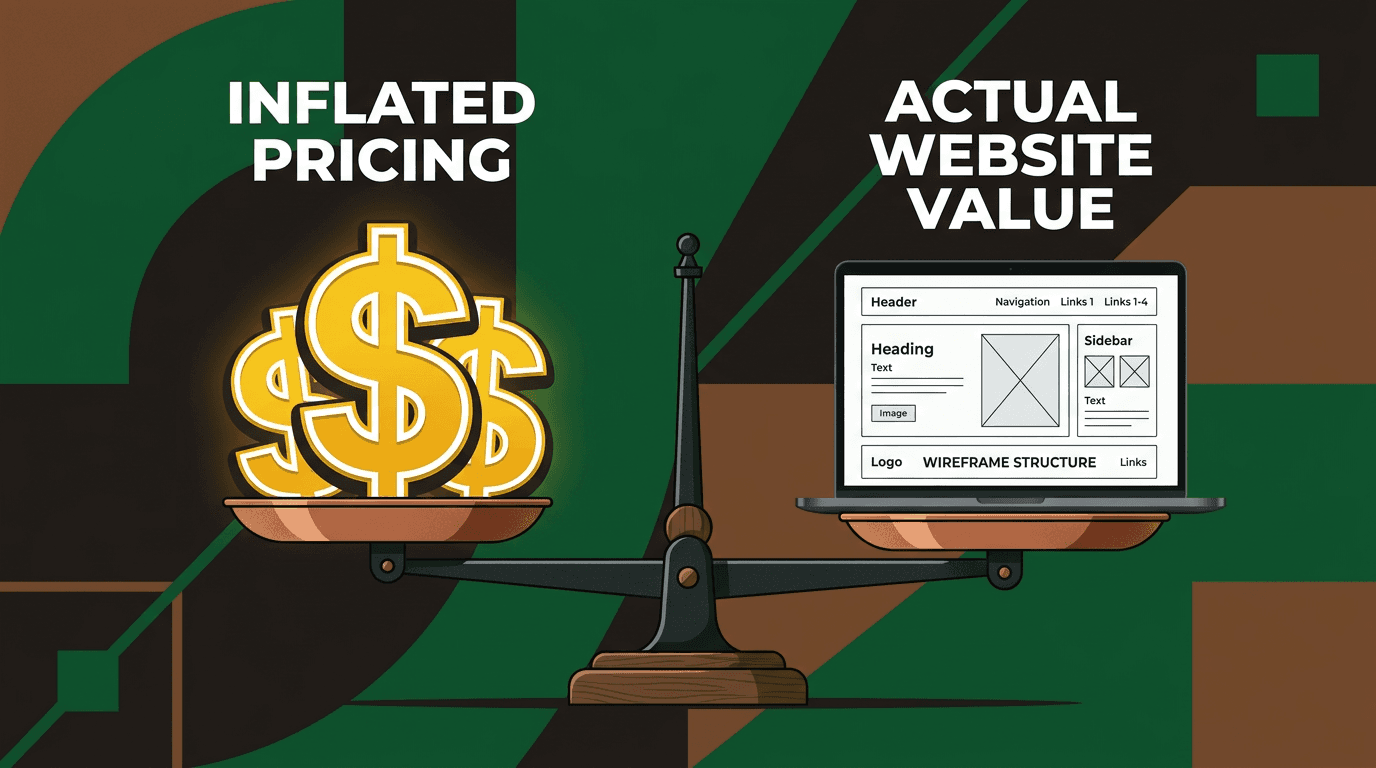
This happens every day across America. Small business owners get quoted $8,000-$15,000 for websites that do the same job as a $1,500 build. The web design industry has perfected the art of scope inflation, and your business pays the price.
Here's what nobody in the industry wants to tell you: most small business websites are deliberately overbuilt. More pages mean bigger invoices. More features mean longer timelines. More complexity means higher ongoing fees.
The $8,000 website that does the same job as a $1,500 one
Picture this scenario. You own a hair salon. You need a website. A local agency sends you a proposal:
- Homepage with custom animations
- About page with team bios
- Full service menu with individual pages for each treatment
- Blog section for "content marketing"
- Gallery page with before/after photos
- Testimonials page
- Contact page with custom forms
- Booking integration page
- COVID protocols page
- Career opportunities page
- Privacy policy and terms pages
- Custom content management system
- SEO optimization package
- Six months of content creation
Total: $8,200 plus $299/month ongoing maintenance.
Sounds professional, right? Here's what your customers actually need:
- Homepage: What you do, where you are, how to book
- Services: What treatments you offer and pricing
- Gallery: Photos of your work (integrated into homepage)
- Contact: Address, hours, phone number, booking link
That's it. Four pages. Your customers want to see your work, check your availability, and book an appointment. They're not reading your blog about hair care trends or your detailed staff bios.
The web design cost for small business has exploded because agencies profit from overbuilding. There's zero incentive to recommend lean, focused sites when bloated ones pay better.
Why agencies sell you more than you need
They bill by scope, not by results
Web agencies make more money when projects are bigger. A $12,000 website with fifteen pages generates more revenue than a $2,000 website with four pages. The quality might be identical, but the invoice isn't.
This creates perverse incentives. Agencies have mastered the proposal padding playbook: extra pages, "content strategy" sessions, custom animations that slow your site down, stock photography packages, and monthly retainers for services you can't define.
I've reviewed hundreds of small business proposals. The pattern is always the same. Take a simple need, wrap it in complexity, and multiply the price by five.
The "you might need it later" trap
"What if you want to add services later?" agencies ask. "What if you need e-commerce functionality? What if you want to start a newsletter?"
This is like buying a pickup truck because you might move someday. Start with what you need now. A focused four-page site can be expanded. A fifteen-page site with stale content actively hurts your search rankings and confuses visitors.
Future-proofing is expensive insurance against problems you may never have. Build for today's needs, not hypothetical tomorrow problems.
Confusing complexity with quality
More pages don't make you look more professional. They make you look unfocused.
User behavior data tells the real story. Most visitors to local business sites view one to three pages maximum. They want specific information quickly. When you force them through a maze of unnecessary pages, they leave.
Google's Core Web Vitals data shows bloated local business sites have bounce rates 40% higher than lean, focused alternatives. Complexity kills conversions.
What your small business website actually needs (and what it doesn't)
The 5-page framework that converts
After building sites for local businesses since 2019, I've identified the lean framework that actually drives calls, bookings, and foot traffic:
1. Homepage Clear headline stating what you do. Your service area. One primary call-to-action (call, book, or visit). Social proof visible above the fold. Nothing else.
2. Services/Menu What you offer with transparent pricing when possible. Don't bury this information. If you're a restaurant, show the menu. If you're a contractor, list your services. Be specific.
3. About Brief trust-builder. Your experience, credentials, or story in 100-150 words maximum. This isn't your autobiography. It's a credibility check.
4. Contact Address, phone number, hours, Google map embed. Contact form if you prefer email leads. Online booking integration if you take appointments.
5. Social proof Customer reviews, before/after photos, or portfolio samples. This can be integrated into your homepage instead of a separate page.
Each page exists for conversion reasons, not design reasons. Every element should either build trust or drive action.
Features that actually move the needle
Focus your budget on functionality that matters in 2026:
- Mobile-first responsive design: 73% of local searches happen on mobile
- Sub-2-second load speed: Google prioritizes fast sites for local search
- Click-to-call integration: Makes phone calls effortless on mobile
- Google Business Profile connection: Your site and listing work together
- SSL certificate: Basic security requirement
- Local schema markup: Helps Google understand your business type and location
These features drive results. Everything else is decoration.
Features you're paying for but don't need
Stop paying premium prices for these invoice-padding additions:
Blogs you'll never update A blog helps SEO only if you publish consistently. Most small business owners don't and won't. An abandoned blog with three posts from 2024 actively hurts your credibility and search rankings.
Custom content management systems WordPress handles 43% of all websites. Squarespace and similar builders power millions more. You don't need a custom CMS unless you're running a complex e-commerce operation.
Thin content pages Pages with under 100 words exist only to pad project scope. They provide no value to visitors and confuse search engines.
Fancy animations and parallax scrolling These features slow load times and impress nobody who's trying to book a haircut or find your phone number.
Premium SEO packages for basic optimization Meta titles, descriptions, and header tags are table stakes, not premium services worth $2,000.
What a small business website should actually cost in 2026
The real price ranges (no fluff)
Here's what different approaches actually cost:
DIY with website builders: $200-$600 annually Squarespace, Wix, or Webflow templates. You handle setup and content. Good for very small businesses with simple needs.
Lean professional build: $1,000-$3,000 one-time Freelancer or focused agency creates a custom 3-5 page site. Includes mobile optimization, basic SEO, and training. This sweet spot works for most local businesses.
Bloated agency build: $5,000-$15,000+ The current industry standard. Multiple pages, custom features, extended timelines, and ongoing retainers. Rarely delivers better results than lean alternatives.
Enterprise development: $15,000+ Custom applications with complex functionality. Local businesses almost never need this level unless they're running sophisticated e-commerce or booking systems.
The small business website cost in 2026 should align with your actual needs, not an agency's revenue targets.
Ongoing costs: what's legitimate vs. what's a cash grab
Hosting: $100-$300 annually is fair. If you're paying $50+ monthly for basic hosting, you're being gouged.
Domain registration: $12-$20 annually for standard domains.
Maintenance retainers: Legitimate only if they include security updates, performance monitoring, and actual improvements. Most $99/month "maintenance" plans are glorified hosting with a markup.
SEO retainers: Justify only with clear deliverables and monthly reporting. Vague "optimization" without measurable results is a cash grab.
The lean site vs. the bloated site: a side-by-side breakdown
I recently built two identical restaurant websites to test this theory:
Bloated approach:
- 12 pages including individual menu sections
- Blog with recipe content
- Staff bio pages
- Custom animations
- 6-week timeline
- $7,500 total cost
- Loads in 4.2 seconds on mobile
Lean approach:
- 4 pages (home, menu, about, contact)
- No blog
- Fast-loading design
- 10-day timeline
- $1,800 total cost
- Loads in 1.8 seconds on mobile
Results after three months: the lean site generated 23% more phone calls and 31% more online orders. Customers care about speed and clarity, not page count.
The lean site isn't a "cheap" site. It's a focused site. There's a difference.
"But don't I need a blog for SEO?"
This objection comes up every time I recommend skipping the blog. Here's the truth: a blog helps SEO only if you publish high-quality content consistently. Most small business owners start with good intentions, publish three posts, then abandon it.
An outdated blog with posts from 2024 signals to Google that your site isn't maintained. It actually hurts your rankings.
What drives local SEO in 2026:
- Optimized Google Business Profile
- Consistent customer reviews
- Accurate business listings across directories
- Fast-loading, mobile-friendly website
- Clear service and location pages
If you commit to publishing weekly blog posts for at least a year, go for it. Otherwise, invest that budget in features that actually work.
How to tell if your current site is overbuilt
Run through this quick audit:
-
Do you have pages with fewer than 100 words? These thin pages hurt more than they help.
-
When did you last update your blog? If it's been over two months, delete it.
-
Can you edit your site without calling your developer? You should control basic updates.
-
Does your site load in under 3 seconds on mobile? Test with Google's PageSpeed Insights.
-
Which pages do visitors actually view? Check Google Analytics. You might be surprised how many pages get zero traffic.
-
Are you paying monthly fees you can't explain? If you don't know what you're paying for, you're probably paying too much.
If you answered poorly to most questions, your site is likely overbuilt and underperforming.
What to do next (whether you're starting fresh or starting over)
If you don't have a site yet: Start lean. Find a freelancer or small agency that specializes in focused builds for local businesses. Avoid anyone who insists you need a blog or double-digit page count. Get it live in two weeks, not two months.
If you already overpaid: Don't panic. Audit your existing content. Consolidate or delete thin pages. Stop paying for unused services. Redirect unnecessary pages to relevant ones.
If you're getting quotes now: Ask agencies to justify every page and feature in conversion terms. If they can't explain how a particular element will drive calls or bookings, remove it from the scope.
The web design industry profits from complexity. Your business profits from clarity. Choose accordingly.
Focus on what your customers actually need: clear information, fast performance, and easy ways to contact you. Everything else is just expensive decoration.
Ready for a website that actually serves your business instead of your designer's portfolio? We build lean, conversion-focused sites for real businesses at honest prices. No bloat, no BS, just results.