Professional Website Design Cost: What You're Actually Paying For in 2026
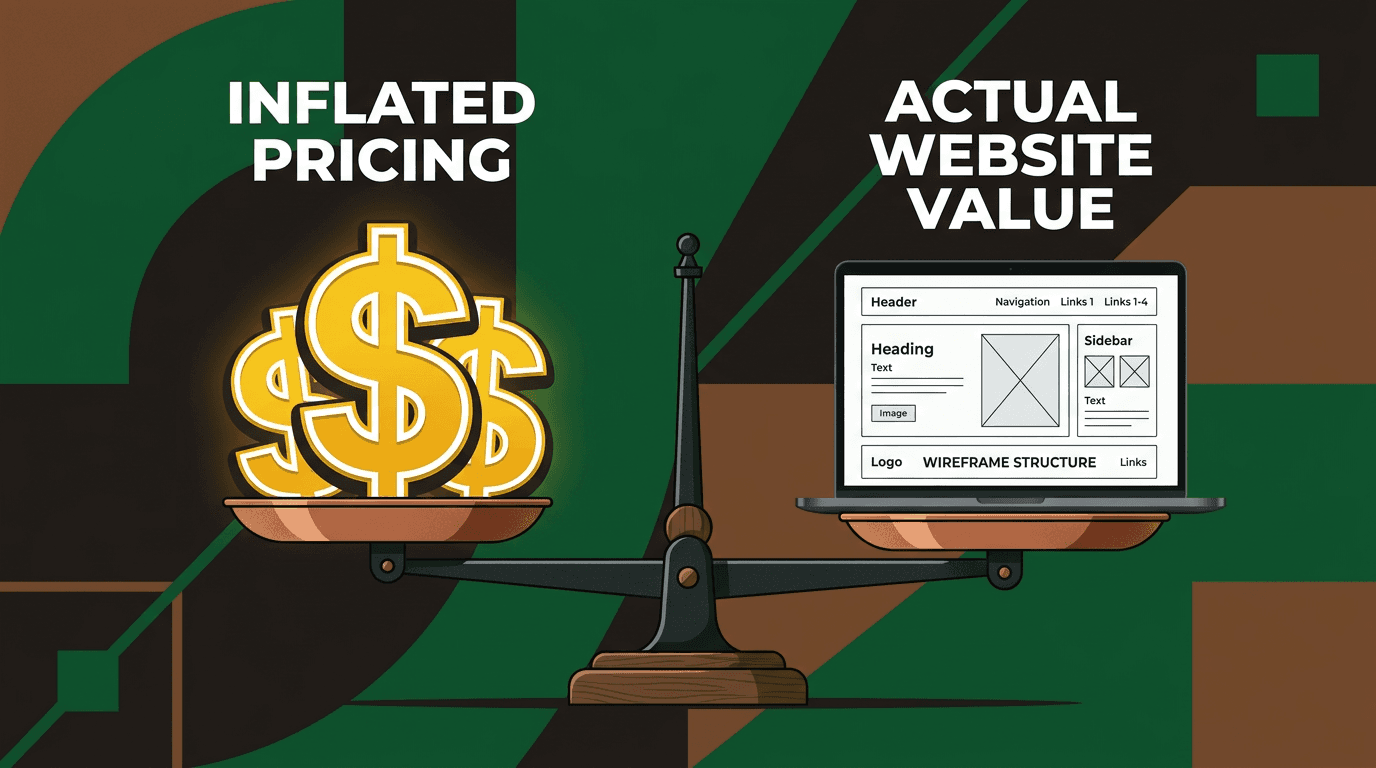
Your neighbor's cousin builds websites for $500. Meanwhile, agencies are quoting $15,000 for what looks like the same thing on the surface.

Your neighbor's cousin builds websites for $500. Meanwhile, agencies are quoting $15,000 for what looks like the same thing on the surface.
Here's what nobody tells you: that $500 website isn't actually $500. It's an installment plan disguised as a one-time fee. Over three years, you'll pay it back through plugin fixes, security patches, lost leads, and eventually a complete rebuild — often costing more than the professional site you avoided buying.
Professional website design costs between $8,500 and $25,000 for small businesses in 2026. Cheap websites cost $500 upfront, then bleed you slowly through technical debt, poor performance, and missed opportunities.
The question isn't whether you can afford professional design. It's whether you can afford not to invest in it.
The price gap is real — but so is the quality gap
Let's acknowledge the elephant: you absolutely can build a website for almost nothing. Current website design costs in 2026 span a massive range:
- DIY builders: $0–$500 annually
- Freelance/basic: $2,000–$7,000
- Professional/agency: $8,500–$25,000
- Enterprise custom: $25,000–$100,000+
The pricing isn't random. Each tier reflects fundamentally different approaches to building websites. Cheap sites are assembled. Professional sites are engineered.
The question isn't whether cheap sites exist. It's what they silently cost you over the next three years — in lost credibility, missed leads, and emergency fixes that always seem to happen at the worst possible moment.
What a cheap website actually looks like under the hood
Template dependency and brand invisibility
Your $500 website uses the same template as hundreds of other businesses. The same header layout. The same button styles. The same generic stock photos of people pointing at laptops and shaking hands.
Your plumbing company ends up looking identical to a yoga studio in Vermont. Your law firm shares a design with a pet grooming service in Texas. Template-based websites create brand invisibility — you become one face in a crowd of identical sites.
Professional sites build custom layouts around your specific audience, industry, and goals. Every color choice, every font pairing, every button placement serves your brand strategy. The difference isn't just aesthetic — it's strategic.
Performance problems you won't notice until they hurt you
Cheap websites are performance disasters waiting to happen. Bloated code, unoptimized images, and plugin conflicts create sites that load slowly and frustrate visitors.
Core Web Vitals — Google's speed and user experience metrics — separate functional sites from broken ones. LCP (Largest Contentful Paint) measures how quickly your main content loads. CLS (Cumulative Layout Shift) tracks whether your page jumps around while loading. INP (Interaction to Next Paint) measures how quickly your site responds to clicks.
Poor Core Web Vitals directly impact search rankings. Slow sites rank lower. Lower rankings mean fewer visitors. Fewer visitors mean fewer leads. The math is brutal and unavoidable.
Security gaps and technical debt
Cheap websites skip security basics. No regular updates. No vulnerability patching. No backup systems. No SSL certificates (or expired ones that trigger browser warnings).
Technical debt accumulates like interest on a credit card. Every shortcut becomes a bill later. Every skipped update becomes a security risk. Every plugin conflict becomes an emergency repair job.
When your site gets hacked — and unprotected sites do get hacked — you're looking at malware cleanup costs, Google blacklist removal, and complete trust recovery. The repair bill alone often exceeds what a professional site would have cost.
The "you're on your own" problem
Cheap website providers disappear after launch. No training. No support. No update path. You're handed login credentials and expected to figure out the rest.
Research shows that clients often wait six weeks for "seven-day" deliverables, or never receive the final site at all. When problems arise — and they will — you're troubleshooting alone or paying someone new to fix someone else's work.
What you're actually paying for with a professional website
Strategy before a single pixel gets designed
Professional website projects start with discovery. Competitive analysis. User flow planning. Wireframing. Understanding your audience's decision-making process.
This strategy phase often costs more than an entire cheap build — and it's the most valuable part. Professional sites are built to convert visitors into customers, not just exist on the internet.
Cheap sites skip strategy entirely. They assume every business needs the same generic layout with the same generic pages. Professional sites build custom conversion paths based on how your specific customers actually buy from you.
Custom design that builds trust in seconds
First impressions happen in 50 milliseconds. Professional website design immediately signals credibility through tailored layouts, consistent branding, and intentional typography.
Professional sites include trust signals that cheap sites miss: proper social proof placement, clear calls-to-action, professional photography, and layouts that guide visitors toward conversion actions.
Custom design isn't about looking pretty. It's about looking trustworthy, credible, and worth doing business with. In competitive markets, visual credibility determines whether visitors stay or leave within seconds.
Performance engineering
Professional sites are built for speed from day one. Image compression. Code optimization. Mobile-first responsive design. Sites engineered to pass Core Web Vitals testing.
Performance directly impacts SEO rankings. Faster sites rank higher. Higher rankings drive more traffic. More traffic generates more leads. Performance engineering pays for itself through improved search visibility.
Professional developers test across devices, browsers, and connection speeds. They build sites that work perfectly whether someone visits from a new iPhone or an old Android over slow cellular data.
SEO foundations baked in from day one
Professional sites include SEO architecture from the ground up. Proper site structure. Schema markup. Metadata strategy. Internal linking systems. Page speed optimization.
Cheap sites treat SEO as an afterthought or ignore it completely. Poor site architecture, missing schema, and slow load speeds create SEO problems that require expensive fixes later.
SEO recovery after a bad build costs $500–$2,000 per month for 6–12 months. Professional sites avoid this expense by building SEO foundations correctly from launch.
Security, scalability, and ongoing support
Professional builds include SSL certificates, regular backups, update schedules, and vulnerability monitoring. Sites built to handle traffic growth and feature additions without complete rebuilds.
Post-launch training helps you make basic content updates yourself without breaking anything. Professional developers document their work and provide support systems for ongoing maintenance.
Professional sites scale with your business growth. Cheap sites hit walls and require complete rebuilds when you need to add functionality or handle increased traffic.
The 3-year cost comparison (the math nobody shows you)
Here's the total cost of ownership that nobody calculates:
Cheap website ($500 initial build)
- Year 1: Build ($500) + hosting ($600) + plugin fixes ($300) + lost leads from poor SEO/performance (estimated $2,000+ in missed revenue) = $3,400+
- Year 2: Security cleanup after hack ($800) + SEO recovery campaign ($3,000) + patch fixes ($500) + continued lost leads = $4,300+
- Year 3: Complete redesign/rebuild ($5,000) + migration costs ($500) + downtime during transition = $5,500
3-Year Total: $13,200+ (plus quantifiable revenue loss from poor performance)
Professional website ($10,000 initial build)
- Year 1: Build ($10,000) + hosting ($600) + maintenance ($1,200) = $11,800
- Year 2: Maintenance ($1,200) + minor updates ($500) = $1,700
- Year 3: Maintenance ($1,200) + minor updates ($500) = $1,700
3-Year Total: $15,200 (with consistent lead generation from day one)
The cheap website costs nearly as much as the professional site — while underperforming the entire time. This is what I call "The $500 Website Tax" — a recurring penalty on your growth that disguises itself as savings.
When a cheap website might actually be fine
Not every business needs a $10,000+ website right now. Be honest about your situation:
Cheap sites work for: Pre-launch validation projects, personal portfolios, side businesses, or companies that generate zero leads online and just need basic contact information displayed.
The key question: Does your website need to generate revenue or just exist?
Even budget-conscious businesses should understand "cheap but smart" versus "cheap and reckless." Smart budget sites use clean templates, prioritize speed, and include basic SEO. Reckless budget sites ignore performance, security, and user experience completely.
How to know what level of website your business needs
Score yourself on these factors:
Annual revenue:
- Under $100K: 1 point
- $100K–$500K: 2 points
- $500K+: 3 points
Lead generation:
- Website doesn't generate leads: 0 points
- Website should generate leads: 2 points
- Website is primary lead source: 3 points
Market competition:
- Low online competition: 1 point
- Moderate competition: 2 points
- High competition: 3 points
Growth plans:
- No growth planned: 0 points
- Moderate growth expected: 2 points
- Aggressive growth planned: 3 points
Previous website experience:
- No previous website: 1 point
- Previous website worked fine: 1 point
- Previous website failed: 3 points
Scoring:
- 0-5 points: DIY or basic template might work
- 6-10 points: Mid-range professional build recommended
- 11+ points: Full professional website essential
If you scored in the professional range, budget accordingly. Trying to save money on something your business depends on is expensive.
What professional website design costs in 2026 (specific numbers)
Current professional website design costs break down by complexity:
| Website Type | Typical Cost Range (2026) | |---|---| | Basic professional site (5–10 pages) | $5,000–$10,000 | | Small business custom site | $10,000–$25,000 | | E-commerce | $10,000–$50,000+ | | Enterprise / custom platform | $25,000–$100,000+ |
Ongoing costs:
- Hosting: $15–$150/month
- Basic maintenance: $500–$2,000/year
- Advanced maintenance: $2,000–$10,000/year
- SEO/marketing: $500–$2,000/month
Platform impact on pricing:
- WordPress: $2,000–$12,000
- Webflow: $2,500–$10,000
- Shopify: $3,500–$30,000+
- Custom development: $12,000–$75,000+
Regional pricing varies significantly. North American agencies charge $75–$200/hour. Offshore developers charge $20–$75/hour. The quality gap often matches the price gap — you get what you pay for in experience, communication, and results.
The bottom line — what you're really paying for
You're not paying for "a website." You're paying for strategy, performance, credibility, security, and compound returns over time.
Cheap websites are an expense that keeps costing money. Professional websites are infrastructure that generates revenue while requiring minimal ongoing investment.
The professionals who charge $10,000+ aren't overpricing websites. They're pricing the strategy, engineering, and support systems that make websites actually work for your business instead of against it.
If your website needs to generate leads or sales — not just exist — professional design pays for itself through better conversion rates, search rankings, and long-term reliability. The math becomes obvious once you calculate the true three-year cost of ownership.
Frequently asked questions
Is it worth paying for professional web design? If your website generates leads or sales, professional design pays for itself through better conversion rates and search rankings. Studies show that professional sites convert 3-5x better than template-based sites.
How much should a small business pay for a website in 2026? Budget $8,500–$15,000 for a professional small business website. This includes strategy, custom design, SEO foundations, and ongoing support. Cheaper options create more problems than they solve.
What is the difference between a cheap and professional website? Cheap sites use generic templates and skip strategy, security, and performance optimization. Professional sites build custom solutions based on your audience, include proper SEO foundations, and provide ongoing support.
Why do some web designers charge $500 and others charge $10,000? The $500 designer assembles a template. The $10,000 team provides strategy, custom design, performance engineering, SEO foundations, and ongoing support. Different services, different outcomes.
Can I start cheap and upgrade later? Starting cheap often means rebuilding completely later. Poor site architecture, bad code, and SEO problems don't upgrade — they require replacement. Starting with professional development costs less long-term than cheap sites that need complete rebuilds.