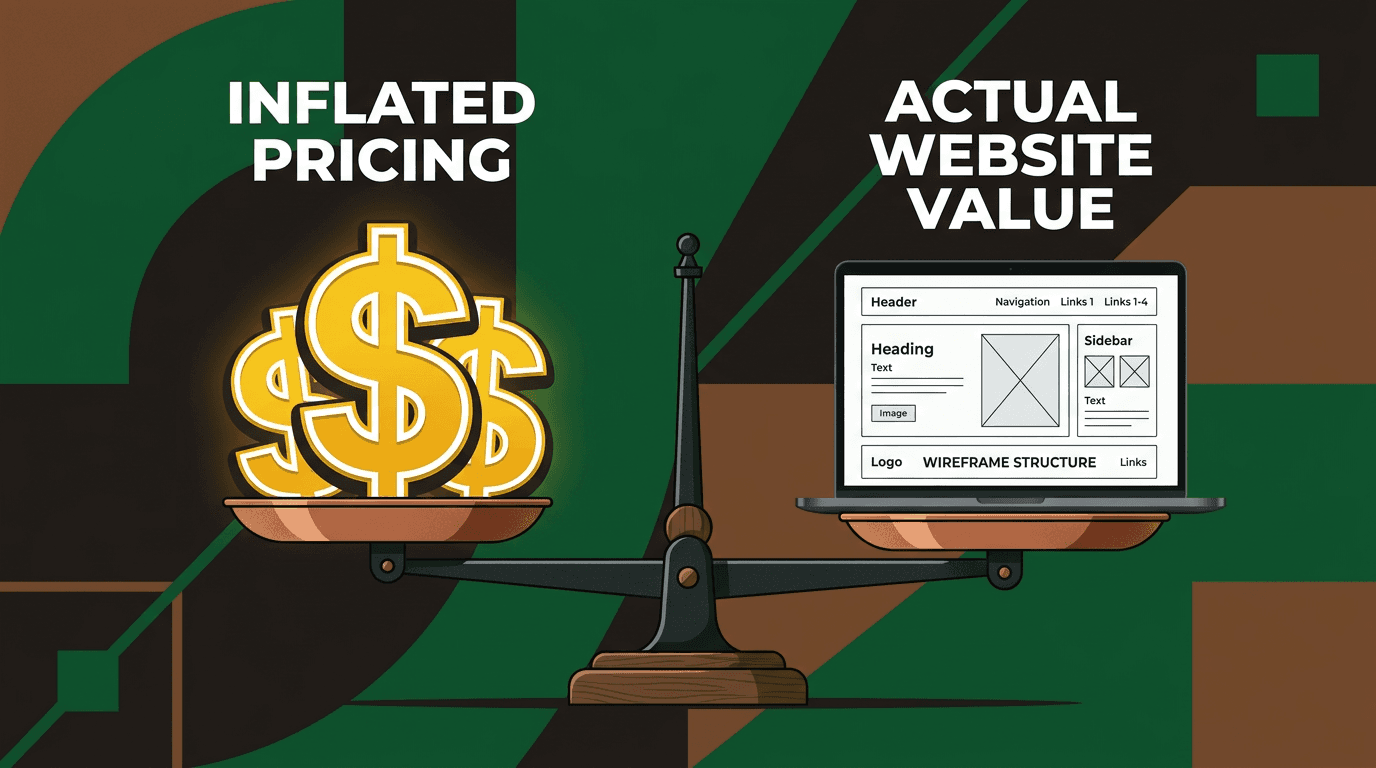
The Hidden Truth: Why Cheap Websites Cost More Than Professional Ones
That $500 website deal sounds perfect when you're bootstrapping a business. Template design, basic pages, mobile-friendly — what more could you need?

That $500 website deal sounds perfect when you're bootstrapping a business. Template design, basic pages, mobile-friendly — what more could you need?
Here's what nobody tells you: cheap websites are payment plans for expensive problems. The real cost isn't the upfront price. It's everything that comes after.
I've watched hundreds of businesses make this mistake. They start with a bargain website and end up spending three times more than they would have on a professional site. The math is brutal, and it's predictable.
The $500 website that cost $47,000
Sarah's landscaping company needed a website fast. A budget freelancer on Upwork promised her a "professional" site for $400. Five pages, contact form, mobile-responsive design. It looked decent enough in the screenshots.
Three months later, the cascade began.
Her Google Ads were driving traffic, but nobody was calling. The site took 8 seconds to load on mobile. Half her images broke on different devices. The contact form sent inquiries to her spam folder. When she tried to fix these issues, her developer had vanished.
She hired another freelancer for $600 to "fix the problems." They broke three more things while fixing two.
By month 10, Sarah was hemorrhaging leads. Her $1,200 monthly ad spend generated maybe two calls. Competitors with professional sites were capturing clients she should have won. She finally invested $5,000 in a proper redesign.
The math was brutal:
- Original site: $400
- Failed fixes: $600
- Lost leads (estimated): $32,000 (16 potential clients × $2,000 average job)
- Wasted ad spend: $9,600 (8 months × $1,200)
- Professional redesign: $5,000
- Total damage: $47,600
The cheapest option turned out to be the most expensive decision she made all year.
What professional website design actually costs in 2026
Let's cut through the confusion. Website design costs vary wildly, but here's what you'll actually pay for different types of websites in 2026:
| Website Type | Upfront Cost | Monthly Cost | Best For | |---|---|---|---| | DIY Builders (Wix, Squarespace) | $0-$500 | $15-$60 | Simple brochure sites, minimal features | | Budget Freelancers (Fiverr, Upwork) | $300-$1,500 | $0-$50 | Very tight budgets, basic requirements | | Professional Small Business Sites | $3,000-$10,000 | $100-$300 | Most businesses, growth-focused | | Agency/Custom Builds | $10,000-$50,000+ | $200-$500+ | Complex functionality, enterprise needs |
For most small businesses, the sweet spot sits between $3,000-$8,000. Not because that's what agencies charge, but because that's what it actually costs to build something that works as a business tool.
The price differences come down to strategy, user experience, SEO foundation, conversion optimization, and post-launch support. A $500 site gives you pages. A $5,000 site gives you a system that brings in business while you sleep.
You don't need to spend a fortune. You need to spend intentionally.
The 7 hidden costs of a cheap website
1. The redesign cycle
Cheap sites get rebuilt every 12-24 months. Professional sites last 4-5 years.
Each rebuild costs money, time, and momentum. I see this pattern constantly: $500 initial build → $500 "fix" at month 6 → $3,000 proper rebuild at month 18. That's $4,000 spent to get what a $3,000 professional site would have delivered from day one.
2. Lost leads you never see
56% of consumers won't trust a business without a professional website. But trust isn't binary — it's a conversion rate.
A cheap site converting at 1% instead of 3% on 500 monthly visitors costs you 10 leads per month. With a $2,000 average customer value, that's $20,000 in lost revenue annually. You'll never see these leads in your analytics because they bounce before engaging.
3. The conversion tax on your marketing
Here's a concept that'll change how you think about websites: The Conversion Tax.
Every dollar you spend on ads, SEO, or social media gets taxed by a website that doesn't convert. Spend $1,000 monthly on Google Ads driving traffic to a 1% converting site versus a 3% converting site. That's the difference between 10 leads and 30 leads from identical ad spend.
Your website isn't just a destination. It's a multiplier — or a drain.
4. Your time (and it's not free)
DIY builds consume 40-100+ hours of the owner's time. If your time is worth $75-$150 per hour, that "free" website costs $3,000-$15,000 in opportunity cost.
Ongoing troubleshooting, plugin conflicts, and small fixes add 5-10 hours monthly. Business owners consistently underestimate the time investment required for DIY solutions.
5. SEO debt that compounds
68% of small business websites lack basic SEO. Cheap builds often skip proper site structure, metadata, schema markup, and page speed optimization.
Poor technical SEO means you're invisible on Google. The longer you wait to fix it, the harder recovery becomes. Competitors who invest early build domain authority that becomes increasingly difficult to match.
This debt compounds. Every month you're invisible is another month they're capturing your potential customers.
6. Security and liability exposure
Neglected plugins and outdated themes are breach vectors. Budget builds rarely include security monitoring, regular backups, or SSL configuration.
Data breaches cost small businesses an average of $2.98 million according to IBM's 2025 data. Even minor security incidents damage customer trust and require expensive remediation.
7. The credibility hit you can't measure
80% of internet users are more likely to buy from a business with a professional website. Your site is often the first real interaction someone has with your business — before they call, email, or visit.
A cheap site doesn't just fail to impress. It actively plants doubt. "If they cut corners on their website, where else do they cut corners?"
The 3-year total cost of ownership — cheap vs. professional
Here's the math that matters — total cost over three years:
| Cost Category | Cheap Site ($500 Build) | Professional Site ($6,000 Build) | |---|---|---| | Upfront cost | $500 | $6,000 | | Redesign (Month 18) | $3,000 | $0 | | Annual maintenance | $600 | $1,200 | | Owner's time (Year 1) | $4,500 (60 hrs × $75) | $750 (10 hrs × $75) | | Lost leads (3 years) | $36,000 | $0 | | Wasted ad spend | $6,000+ | Minimal | | 3-Year Total | $50,600+ | $9,150 |
These numbers are illustrative but conservative. The cheap site costs 5.5 times more over three years.
The $500 website isn't a deal. It's a payment plan for pain.
What a lean, professional website actually includes
"Lean" doesn't mean cheap. Lean means strategic — every dollar spent on features that drive business results.
A $3,000-$8,000 small business website should include:
- Custom design that reflects your brand (not a reskinned template)
- Mobile-responsive, fast-loading pages (under 3 seconds)
- SEO foundation (proper site structure, metadata, schema markup, Core Web Vitals optimization)
- Clear conversion pathways (strategic calls-to-action, optimized contact forms, booking integration)
- Professional copywriting or content strategy guidance
- Security basics (SSL certificates, regular backups, updated tech stack)
- 30-90 days of post-launch support and training
You're not paying for pixels. You're paying for a system that generates leads and sales while you focus on running your business.
How to know if your current website is costing you money
Run this quick diagnostic on your current site:
Speed test: Does your site load in under 3 seconds on mobile? Test it at Google PageSpeed Insights.
Local visibility: Google your business name plus your city. Do you appear on page one?
Conversion focus: Does every page have a clear, prominent call-to-action?
Content freshness: Have you updated your site's content or design in the last 12 months?
Analytics awareness: Do you know your site's conversion rate? If not, that's a red flag.
User feedback: Have visitors mentioned that your site looks outdated or is hard to navigate?
Marketing confidence: Are you comfortable sending paid traffic to your current site?
If you answered "no" to three or more questions, your website is likely costing you more than it's making.
The bottom line — spend smart, not cheap
The question isn't "Can I afford a professional website?" It's "Can I afford not to have one?"
Businesses with effective websites grow revenue 40% faster than those without. Professional websites are 2.8 times more likely to drive revenue growth.
You don't need the most expensive site on the market. You need one that actually works as a business tool — that converts visitors into customers, ranks on Google, loads quickly, and represents your brand professionally.
The lean-but-effective philosophy means spending the right amount in the right place so nothing is wasted. For most businesses, that sweet spot sits between $3,000-$8,000. Not because that's what it should cost in theory, but because that's what it takes to build something that actually drives results.
Stop thinking about website cost as an expense. Start thinking about it as the foundation of your digital revenue engine. The cheapest option is rarely the smartest one.
Frequently Asked Questions
How much should a small business website cost in 2026? Most small businesses should budget $3,000-$8,000 for a professional website. This includes custom design, mobile optimization, SEO foundation, and conversion optimization features that actually drive business results.
What makes a cheap website more expensive in the long run? Cheap websites typically require rebuilds every 12-24 months, convert poorly (costing you leads), load slowly (hurting SEO), and lack security features. The total cost over 3 years often exceeds $50,000 when you factor in lost revenue and constant fixes.
How can I tell if my website is costing me money? If your site loads slowly (over 3 seconds), doesn't rank on Google, lacks clear calls-to-action, or hasn't been updated in over a year, it's likely costing you leads and revenue daily.
Is it worth paying more for professional website design? Yes. Professional websites last 4-5 years, convert 2-3 times better than cheap sites, and provide a positive ROI through increased leads and sales. The upfront investment pays for itself within months.
What's the difference between a $500 and $5,000 website? A $500 website gives you basic pages. A $5,000 website gives you a lead generation system with proper SEO, fast loading, mobile optimization, security features, and ongoing support that actually brings in business.
Ready to stop losing money on a cheap website? Calculate what your current site is actually costing your business, and discover how a professional website can become your most profitable investment.