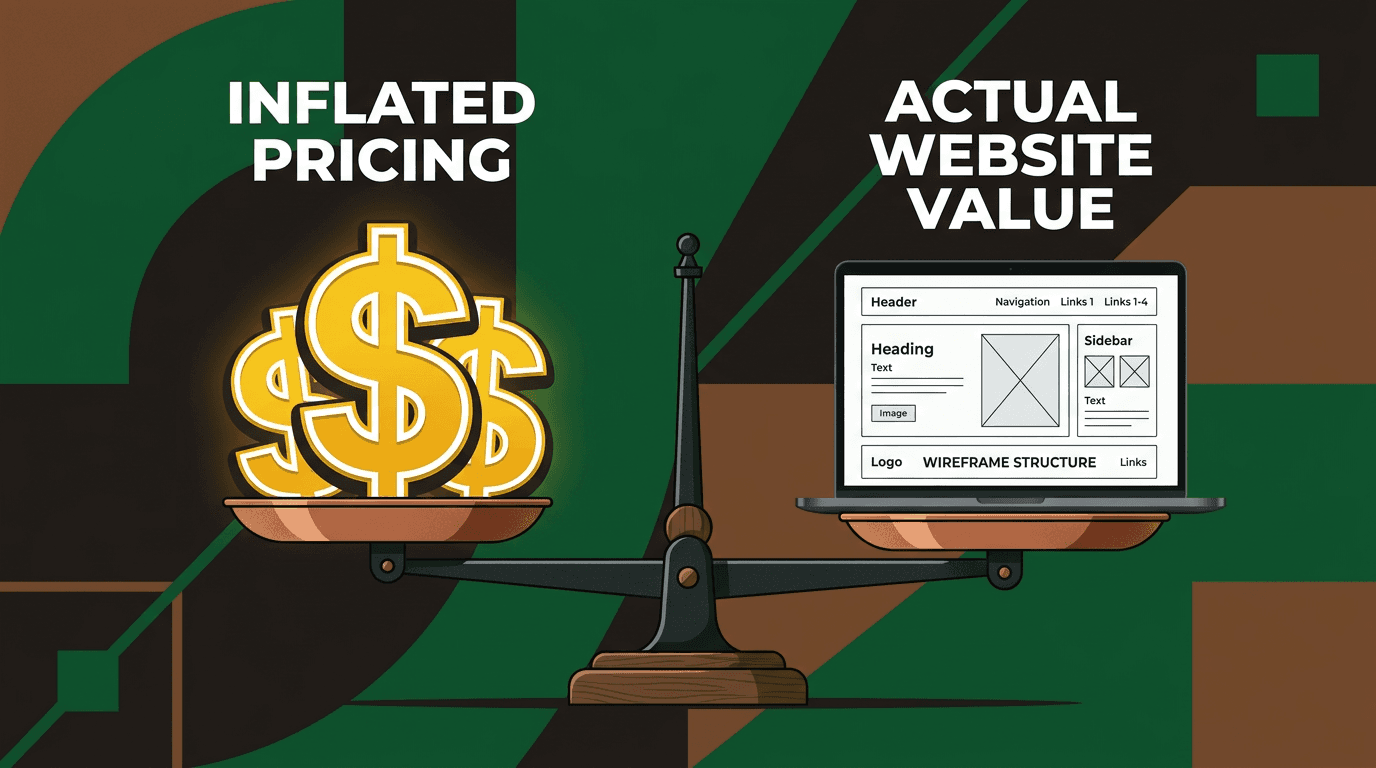
Hidden fees that inflate your website bill: The real web design cost for small business
Sarah thought she'd found the perfect web design deal. A clean, professional quote for $3,200 to build her marketing consultancy's website. Five pages, mobil...

Sarah thought she'd found the perfect web design deal. A clean, professional quote for $3,200 to build her marketing consultancy's website. Five pages, mobile-responsive, delivered in six weeks.
Eight months later, her total bill hit $11,847.
Her story isn't unique. The sticker price for web design cost for small business rarely reflects what you'll actually pay. Between hosting markups, content upsells, and maintenance traps, that initial quote becomes a starting point for an expensive journey you never signed up for.
I've dissected hundreds of web design invoices and contracts over the past three years. The pattern is consistent: legitimate $5,000 projects that balloon to $12,000, simple brochure sites that spawn $200 monthly hosting bills, and "all-inclusive" packages that exclude everything you actually need.
Some fees are predatory markup. Others represent genuine value you should gladly pay for. The trick is knowing which is which before you sign anything.
The $3,000 website that became $11,000
Sarah's original quote seemed straightforward:
Initial Proposal: $3,200
- 5-page responsive website
- Contact form integration
- Basic SEO setup
- 30 days post-launch support
Final Invoice Total: $11,847
Here's how the costs actually broke down:
| Line Item | Cost | |-----------|------| | Original Quote | $3,200 | | Content writing (discovered week 2) | $1,800 | | Stock photography package | $650 | | Premium hosting setup | $180 | | SSL certificate (annual) | $199 | | Additional pages (3 service pages) | $1,200 | | Revision rounds 3-7 | $875 | | SEO optimization add-on | $1,200 | | Contact form spam protection | $240 | | Mobile optimization (yes, separate charge) | $800 | | Google Analytics setup | $180 | | Site backup system | $220 | | Domain registration and DNS setup | $150 | | Rush delivery fee (their missed deadline) | $520 | | Mandatory maintenance plan (6 months) | $1,432 | | Final Total | $11,847 |
The $3,200 quote covered exactly one thing: building five empty page templates. Everything else — content, images, actual functionality — was an upsell.
This isn't an extreme case. According to 2025 data from OneLittleWeb, 67% of small business website projects exceed their initial quote by 40-150%. The web design cost for small business advertised is almost never the price you pay.
Why the sticker price is never the real price
The low-ball-then-upsell model works because switching providers mid-project is painful. You've already invested time in discovery calls, shared your brand assets, and committed to a timeline. When week three brings a $1,500 "content creation invoice," most business owners pay it rather than start over.
Smart agencies structure their quotes this way intentionally. The core build gets priced competitively to win the contract. The profit comes from add-ons that feel necessary once you're committed.
Not every provider operates this way. Some agencies quote comprehensive packages upfront with transparent line items. Others genuinely discover scope additions during legitimate project evolution.
The difference lies in how these additional costs get presented and when they're disclosed. Predatory providers spring surprise fees without warning. Ethical ones discuss potential extras during the proposal phase and get written approval before adding any billable work.
12 hidden fees that inflate your website bill
1. Hosting markup
What it is: Your provider charges $50-$150 monthly for hosting that actually costs $5-$30 through major hosts like SiteGround or Cloudways.
Green flag: Transparent managed hosting with clear added value. They handle security monitoring, daily backups, uptime guarantees, and performance optimization. You're paying for service, not just server space.
Red flag: Vague "hosting fees" with no breakdown of what's included beyond basic server access. Premium business hosting typically costs $20-$40 monthly, so anything above $60 needs detailed justification.
Real numbers: Quality shared hosting runs $8-$25 monthly. Managed WordPress hosting from reputable providers costs $20-$50. If you're being charged $100+ monthly for a basic business site, you're paying 300-400% markup.
2. SSL certificate upsell
What it is: Charging $100-$300 annually for SSL certificates that come free with modern hosting through Let's Encrypt.
Green flag: Extended validation SSL certificates for e-commerce sites that process sensitive customer data. These provide higher security levels and cost $100-$300 annually from legitimate certificate authorities.
Red flag: Any charge for basic SSL on a standard business website. In 2026, SSL is baseline security, not a premium add-on.
SSL certificates are non-negotiable for any website. Google flags non-HTTPS sites as insecure, and most browsers display warning messages. Any provider charging extra for basic SSL is either uninformed or opportunistic.
3. Stock photos and media
Typical surprise: $500-$2,000 added for "professional imagery" sourced from stock libraries.
Green flag: High-quality licensed images from premium libraries like Getty or Adobe Stock, with transparent per-image pricing and client approval before purchase. Professional photography shoots planned and budgeted upfront.
Red flag: Bulk-billing generic stock photos at premium rates without showing you options or getting approval. Charging $50-$100 per image for standard Shutterstock photos that cost $10-$15.
Alternative approach: Free resources like Unsplash and Pexels offer high-quality images for most business needs. For unique brand imagery, invest in one professional photo shoot rather than paying markup on stock libraries.
4. Premium plugins and theme licenses
What it is: WordPress plugins and themes with annual renewal fees ($50-$500 yearly) billed through your provider at significant markup.
Green flag: Recommending specific tools like Elementor Pro or Advanced Custom Fields with transparent license costs transferred directly to your account. You own the licenses and can manage renewals independently.
Red flag: Installing proprietary or white-labeled plugins that lock you into their ecosystem. Charging $200 annually for plugins you could license directly for $50.
Popular tools like Elementor Pro cost $59 yearly when purchased directly. WooCommerce extensions range from $29-$199 annually. Any provider charging 2-3x these rates is adding unnecessary margin.
5. Content and copywriting
The most common surprise: Quotes mention "5-page website" but content creation isn't included in the build cost.
Typical additional cost: $1,000-$3,000 for professional copy covering 5-10 pages.
Green flag: Content scoped as a separate deliverable with clear word counts, revision rounds, and timeline. Professional copywriters typically charge $100-$300 per page for business websites.
Red flag: Presenting "we build your website" as all-inclusive, then sending mid-project invoices for content creation without prior discussion.
Quality website copy requires research, strategy, and multiple revision rounds. It's legitimate billable work when scoped appropriately. The problem arises when providers imply content is included, then spring surprise charges during development.
6. Additional pages beyond the quote
Standard pattern: Initial quotes cover 5-8 pages. Every additional page costs $200-$400.
Green flag: Per-page pricing disclosed upfront in the proposal with clear examples of what constitutes a "page" versus a "section."
Red flag: Encouraging additional pages mid-project without discussing cost implications until invoice time.
Modern small business websites average 10-15 pages, including service pages, about sections, and contact forms. Providers who quote only 5 pages know most businesses need more content.
7. Revision and change-order fees
What it is: "Two rounds of revisions included" policies where every subsequent change costs $50-$150 hourly.
Green flag: Defined revision rounds in the contract with clear hourly rates for additional work. Professional developers typically charge $75-$150 hourly for changes outside the original scope.
Red flag: No revision policy stated upfront, then surprise invoices for "additional labor" on minor tweaks.
Legitimate change orders address genuine scope additions — new features, additional integrations, or significant design departures from approved mockups. Charging for basic content updates or minor layout adjustments suggests poor project planning.
8. SEO setup fees
Basic requirement: On-page SEO including meta titles, alt tags, and XML sitemaps should be standard in any professional website build.
Typical upsell: $500-$2,000 for "SEO optimization" that covers these baseline elements.
Green flag: Advanced SEO strategy including keyword research, content planning, and technical audits priced as separate, clearly scoped projects.
Red flag: Charging extra for meta titles and alt tags on a website they're already building.
In 2026, basic SEO isn't optional. Any provider treating meta descriptions and image alt text as premium add-ons lacks fundamental web development knowledge.
9. Mobile/responsive design as an "extra"
Bottom line: Responsive design is not optional in 2026. It's baseline functionality.
Red flag (always): Any provider charging extra for mobile responsiveness.
If you see this line item on any quote, walk away immediately. It signals fundamentally outdated practices and technical incompetence.
10. E-commerce and payment gateway fees
Legitimate costs: Transaction fees from payment processors like Stripe (2.9% + $0.30) or PayPal are standard third-party charges you'll pay regardless of your web provider.
Green flag: Transparent explanation of gateway fees and platform costs like Shopify subscriptions or WooCommerce extensions with pricing you can verify independently.
Red flag: Adding "processing integration fees" on top of actual gateway costs, or taking ongoing percentages of your sales as "platform fees."
Real numbers: Stripe and PayPal charge similar rates you can review on their websites. WooCommerce is free open-source software. Shopify costs $29-$79 monthly depending on your plan. Any fees beyond these published rates need detailed justification.
11. Post-launch maintenance plan markups
Typical cost: $100-$500 monthly for "maintenance" covering plugin updates and backups.
Green flag: Itemized plans showing specific deliverables like dedicated support hours, uptime monitoring, security patches, and monthly performance reports.
Red flag: Mandatory maintenance contracts with auto-renewal at higher rates, vague deliverables, or no opt-out provisions.
Legitimate maintenance includes security monitoring, software updates, and technical support. Basic plugin updates and automated backups shouldn't cost $200+ monthly for a standard business website.
12. Domain registration and renewal traps
What it is: Your provider registers your domain under their account, not yours. You don't actually own it.
Renewal markup: Charging $50-$100 annually for domains that cost $10-$15 through registrars like Namecheap or GoDaddy.
Green flag: Domain registered in your name, on your registrar account, with credentials you control completely.
Red flag: Provider "manages" your domain through their account, won't transfer without fees, or uses proprietary DNS settings that complicate future migration.
Domain hostage situations are surprisingly common. Business owners discover they can't access their own websites when relationships with providers sour. Always maintain direct control of your domain registration.
The real web design cost for small business — first year vs. year two
Here's what different approaches actually cost when you factor in hidden fees:
| Provider Type | Upfront Cost | Monthly Ongoing | Common Hidden Fees | True First-Year Cost | Year 2+ Annual Cost | |---|---|---|---|---|---| | DIY Builder | $200-$800 | $15-$50 | $500-$1,500 | $900-$2,900 | $180-$600 | | Freelancer | $1,500-$5,000 | $50-$200 | $1,000-$3,000 | $3,100-$10,400 | $600-$2,400 | | Boutique Agency | $3,000-$10,000 | $100-$400 | $2,000-$5,000 | $6,200-$19,800 | $1,200-$4,800 | | Full-Service Agency | $8,000-$25,000 | $200-$800 | $3,000-$8,000 | $13,400-$42,600 | $2,400-$9,600 |
The key insight: first-year totals typically run 50-200% higher than initial quotes. Industry research from 2025 confirms that $1,500-$6,000 quoted projects often become $5,000-$15,000+ in year one when you include all necessary components.
Red flags in a web design proposal
Watch for these warning signs in any quote:
- No line-item breakdown — just a lump sum with vague deliverables
- "Content not included" buried in fine print
- Mandatory multi-year maintenance contracts with auto-renewal clauses
- Domain/hosting registered under the agency's account instead of yours
- No mention of file ownership or asset transfer upon project completion
- Revision limits not specified or unreasonably restrictive
- No process for scope changes or additional requests
- "Rush fees" without clear timeline definitions
- Proprietary platforms or tools that lock you into their ecosystem
Which fees are actually worth paying for
Professional copywriting — Yes, if you lack time or writing skills. Quality copy directly impacts conversion rates and search rankings.
Managed hosting with real security — Yes, at fair pricing. Security monitoring, automated backups, and performance optimization save time and prevent disasters.
Advanced SEO strategy — Yes, when properly scoped. Keyword research, content planning, and technical audits provide measurable business value beyond basic on-page optimization.
Custom photography — Often yes. Original brand imagery outperforms generic stock photos for building trust and differentiation.
Monthly maintenance with defined deliverables — Yes, if you need ongoing changes and lack technical skills. Legitimate maintenance includes security updates, performance monitoring, and support hours.
Anything proprietary or lock-in dependent — Almost always no. Avoid platforms, plugins, or services that make future migration difficult or expensive.
Your web design quote checklist
Bring this to every vendor conversation:
- Page count clearly defined with examples of what constitutes additional pages
- Revision rounds specified with hourly rates for additional changes
- Content responsibility clarified — who writes copy and sources images
- Hosting details transparent — actual costs and what's included in management fees
- Domain ownership confirmed — registered in your name on your account
- SSL certificate included in base package for any site
- Mobile responsiveness confirmed as standard, not an add-on
- Basic SEO elements included — meta titles, alt tags, XML sitemap
- File ownership specified — you get all source files and assets upon completion
- Post-launch support terms — what's included and for how long
- Plugin transparency — which tools require ongoing license fees
- Timeline and payment schedule — clear milestones tied to deliverables
Copy-paste contract clauses
Use these specific clauses to protect yourself:
- "All deliverables, source files, and website credentials transfer to client upon final payment"
- "Domain shall be registered in client's name using client's registrar account"
- "Monthly maintenance services may be cancelled by client with 30 days written notice"
- "Any work outside original scope requires written approval with cost estimate before proceeding"
Frequently asked questions
How much does a small business website really cost in 2026? Including all necessary components and first-year fees, expect $3,000-$12,000 for a professional business website. The wide range depends on complexity, content needs, and provider type. DIY builders start around $1,000 annually, while full-service agencies often exceed $15,000 in year one.
What is usually not included in web design quotes? Content writing, stock photography, premium plugins, ongoing maintenance, and hosting management are commonly excluded from base quotes. Research shows these "extras" add 40-100% to initial project costs.
How do I know if my web designer is overcharging me? Compare their hosting and domain fees to market rates. Basic hosting costs $10-$30 monthly; domains cost $10-$15 annually. Charges significantly above these amounts need detailed justification. Request itemized breakdowns for all fees and verify costs independently.
Should I pay for a website maintenance plan? Only if it includes specific, measurable deliverables like security monitoring, regular updates, performance optimization, and defined support hours. Avoid plans that only cover basic plugin updates or automated backups — these shouldn't cost $100+ monthly.
Who should own my domain name — me or my designer? Always you. Register domains in your name using your own registrar account with credentials you control. This prevents domain hostage situations and ensures you can change providers without complications.
What should I look for in a web design contract? Clear scope definition, itemized pricing, revision policies, file ownership terms, and cancellation clauses. Avoid contracts with mandatory long-term commitments, auto-renewal fees, or vague deliverables.
The web design industry's pricing opacity isn't accidental. Providers profit from confusion and complexity. But armed with knowledge about common hidden fees and their legitimate alternatives, you can negotiate fair contracts that protect your budget and business interests.
Your website is a critical business asset. Don't let surprise fees and predatory practices turn a reasonable investment into a financial disaster. Use this breakdown to evaluate quotes, negotiate contracts, and build relationships with providers who operate transparently.
The right web design cost for small business is whatever you agree to pay upfront — not whatever appears on invoices months later.