How to Find Businesses That Need Websites: The Complete Prospecting Guide for Web Designers
There's money hiding in plain sight on every main street across America. Walk down any business district, scroll through Google Maps, or scan local Facebook ...

There's money hiding in plain sight on every main street across America. Walk down any business district, scroll through Google Maps, or scan local Facebook groups—you'll spot them everywhere.
Businesses with no website. Companies with sites so broken they might as well not exist. Service providers getting buried by competitors who figured out digital marketing years ago.
The numbers tell the real story. 27% of U.S. small businesses still have no website in 2026. That's roughly 8 million businesses sitting on the sidelines while their competitors collect every online lead in their market.
But here's what most web designers miss completely: of the 73% that do have sites, many are digital disasters waiting for someone to fix them. I'm talking about websites that fail mobile tests, load slower than dial-up, or look like they were built when flip phones were trendy.
These businesses often convert faster than the no-website crowd because they already understand they need a web presence. They just need someone to build them a better one.
Why this opportunity is bigger than you think
The real opportunity runs much deeper than the obvious no-website pool. Research shows that 1 in 5 existing websites have critical errors that kill conversions. We're talking about sites that don't work on mobile, take 8+ seconds to load, or haven't been updated since 2021.
The financial impact hits hard. Businesses without websites lose an average of $17,000 per year and grow 40% slower than competitors with proper online presence.
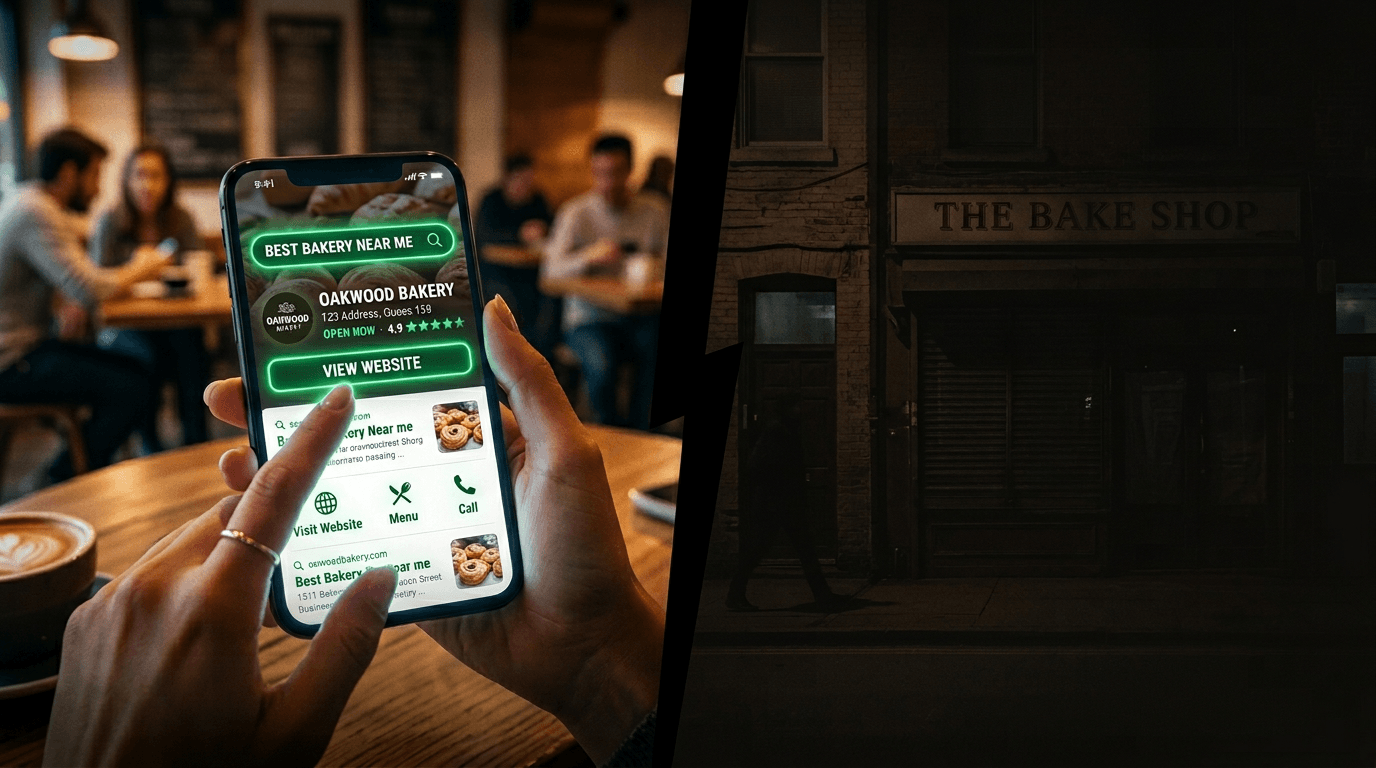
Consumer behavior backs this up completely. 56% of people won't trust a business with no website. When someone searches for "plumber near me" at 10 PM on Sunday, they're calling the first result with a professional site and clear contact info—not hunting down a Facebook page or hoping the Yellow Pages listing works.
The timing couldn't be better. 92% of consumers who find a local business via search will visit or call within 24 hours. Translation: every day without a website is money walking out the door.
Five proven methods to find businesses that need websites
1. Search Google Maps by category and location
Open Google Maps. Search "[service type] in [city]"—try "electricians in Portland" or "restaurants in Nashville." Scan the listings for missing website links.
Look for businesses with phone numbers and addresses but no "Website" button in their Google Business Profile. These are your primary targets.
Pro tip: zoom into specific neighborhoods instead of searching the whole city. Less competition from other agencies, and you'll find smaller businesses that bigger firms ignore completely.
Remember that 64% of consumers check Google Business Profile first before choosing a local service. Businesses without a linked website are bleeding leads to competitors who figured this out years ago.
2. Cross-reference online directories
Check Yelp, Better Business Bureau, and Angi for businesses that maintain directory listings but have no owned domain.
21% of small businesses rely solely on social media or directories instead of building their own website. You'll spot the pattern quickly: Facebook page linked, Instagram account active, website field completely blank.
These businesses understand marketing—they're maintaining multiple profiles and responding to reviews. They just haven't made the jump to owning their own digital real estate.
3. Use Google search operators to expose gaps
Search site:facebook.com "contractor" "Denver" to find businesses whose only web presence is a Facebook page. Try different combinations: site:facebook.com "restaurant" "your city" or site:instagram.com "salon" "your area".
Another powerful angle: search "business type" "city" -site:*.com to surface businesses that show up in directories but don't have their own domain.
These searches are completely free and take minutes. No tools required, no monthly subscriptions.
4. Scan social media groups and local forums
Facebook groups for local business owners and neighborhood communities are goldmines. Search for your city + "business owners" or "entrepreneurs."
Check LinkedIn for local business groups and Chamber of Commerce communities. Many chamber websites list members without including website links—they're literally giving you a prospect list.
Don't overlook Nextdoor, Reddit local subreddits, and Quora threads where business owners ask for marketing advice. Sometimes your prospects are asking questions about whether they need a website at all.
5. Audit existing websites for critical problems
This is the hidden market most web designers ignore completely.
Use Google PageSpeed Insights, Lighthouse, and Google's Mobile-Friendly Test on every website you find. Check for HTTP instead of HTTPS, non-responsive design, load times over 3 seconds (53% of mobile users abandon sites at that threshold), broken contact forms.
Tools like BuiltWith or Wappalyzer will show you if a site runs on Flash, ancient WordPress themes from 2019, or other outdated technology that screams "rebuild me."
A business with a broken website is often an easier sell than one with no website. They already know they need online presence—they just need someone to fix what's not working.
Which industries have the biggest gaps?
Not all businesses are equally likely to need your help. Focus your prospecting on industries where websites are both rare and valuable.
| Industry | Website Gap Rate | Willingness to Pay | Notes | |---|---|---|---| | Contractors & Home Services | High | High | High search demand, historically low web presence | | Restaurants & Cafés | Medium-High | Medium | Many rely only on Yelp and delivery apps | | Salons & Barbershops | Medium-High | Medium | Often maintain Instagram but no website | | Professional Services | Low-Medium | High | Usually have sites, but often severely outdated | | Trades (Plumbers, HVAC, Electrical) | High | High | Referral-dependent, underserve online search |
The psychology breaks down predictably. 35% of no-website owners think their business is "too small," 27% believe websites aren't relevant to their industry, and 26% cite cost concerns.
These objections are weakest in service-based trades where customers actively search online during emergencies. Nobody calls their neighbor for plumber recommendations when their basement is flooding at midnight.
How to qualify your prospects (the 5-point scoring system)
Finding businesses is step one. Qualifying them saves you from wasting weeks chasing prospects who will never buy.
I use a simple 5-point scoring system:
| Signal | Score | Why It Matters | |---|---|---| | 10+ Google reviews | +1 | Active business with real customers | | Service-based (not just retail) | +1 | Higher lifetime value, recurring marketing needs | | No website OR website fails mobile/speed test | +1 | Clear problem you can articulate with data | | Evidence of hiring or expansion | +1 | Revenue available to invest in growth | | Active social media but no owned site | +1 | Already marketing—just missing the hub |
Score 4–5: High-priority prospect. Reach out immediately with personalized outreach.
Score 2–3: Worth contact, but expect a longer sales cycle and more education.
Score 0–1: Move on. They're not ready or not viable.
Example: A plumber in Austin with 47 Google reviews, weekly Facebook posts, job listings on Indeed, and no website scores 5 out of 5. They're busy, visible, growing, and losing leads every single day to competitors with better online presence.
Semi-automated prospecting for scale
Manual methods work when you're starting out. But if you want 50+ qualified prospects per hour instead of 10, add lightweight automation to your process.
Google Maps scraping tools like Botster or Outscraper export Maps listings to spreadsheets, including whether the website field is populated. Sort for blank website fields and you've got your target list.
Use Hunter.io to find owner email addresses. Search LinkedIn for decision-makers at each business. Run batch PageSpeed tests or use Screaming Frog's free version to audit competitor sites at scale.
Always comply with platform terms of service. Personalize your outreach. Nobody wants generic "I noticed your website needs improvement" spam.
The key is using automation for data gathering, not for relationship building. Robots can collect prospects. Only humans can close deals.
How to approach a business about building their website
Lead with their problem, not your service. "I noticed your business has 52 five-star reviews but no website. That means you're invisible to the 97% of consumers who search online before choosing a local service provider."
Use your data as sales ammunition: $17,000 annual revenue loss, 56% consumer distrust without a website, 92% of searchers contact businesses within 24 hours of finding them online.
Offer a concrete next step: free mini-audit of their current online presence, mockup of their homepage, or competitive analysis showing what their top competitors are doing online.
Keep initial contact short. One specific problem. One supporting statistic. One low-risk offer.
87% of businesses without websites plan to build one eventually. You're not convincing them they need it—you're helping them stop procrastinating and start capturing the leads they're losing.
Quick-reference checklist: your local market audit in 30 minutes
☐ Pick 3 service categories in your area (plumbers, dentists, landscapers, etc.)
☐ Search each category on Google Maps. Flag listings with no website link
☐ Google search the first 10 results for each category. Open every website
☐ Run existing sites through PageSpeed Insights. Flag scores below 50
☐ Check Yelp and Facebook for businesses with profiles but no owned domain
☐ Score each prospect using the 5-point system above
☐ List your top 10 highest-scoring prospects
☐ Draft personalized outreach for each. Lead with their specific problem
This 30-minute audit will give you enough qualified prospects to fill your pipeline for weeks. Most web designers spend more time on a single proposal than it takes to find 50 potential clients.
Frequently asked questions
How many businesses don't have a website in 2026? 27% of U.S. small businesses still have no website as of 2026. That represents roughly 8+ million businesses across the country.
Can you use Google Maps to find businesses without websites? Yes. Search any business category plus location on Google Maps. Listings without a "Website" button in their business profile have no linked website. It's the fastest free method available for prospecting.
What types of businesses need websites the most? Service-based local businesses—contractors, plumbers, electricians, salons, and restaurants—have the highest rates of missing or outdated websites, combined with strong local search demand from customers.
How do I approach a business that doesn't have a website? Lead with their specific problem and supporting data. For example: "56% of consumers won't trust a business without a website." Offer a concrete, low-risk next step like a free homepage mockup. Focus on the revenue they're losing, not the features you're selling.
Is it worth targeting businesses with bad websites, not just missing ones? Absolutely. The pool of businesses with broken, slow, or non-mobile-friendly websites is 3–5 times larger than the no-website market. These prospects are often easier to sell because they already understand they need web presence—they just need someone to build them a better one.
Start prospecting today
The opportunity is real. The data backs it up. The tools are free or cheap.
What separates successful web designers from those struggling to find clients isn't talent or pricing—it's knowing where to look and having a system for qualifying prospects before you invest time in outreach.
Start with one industry in your local market. Spend 30 minutes running through the checklist above. Score your prospects. Reach out to your top 5 with personalized messages that lead with their specific problem.
Most of these businesses already know they need help. They're just waiting for someone credible to show them what they're missing and how to fix it.