Your Customers Google You Before They Call You
It's 9 PM on a Tuesday. A homeowner's pipe bursts, flooding their kitchen floor. They grab their phone, heart racing, water spreading. They Google "emergency...
It's 9 PM on a Tuesday. A homeowner's pipe bursts, flooding their kitchen floor. They grab their phone, heart racing, water spreading. They Google "emergency plumber near me."
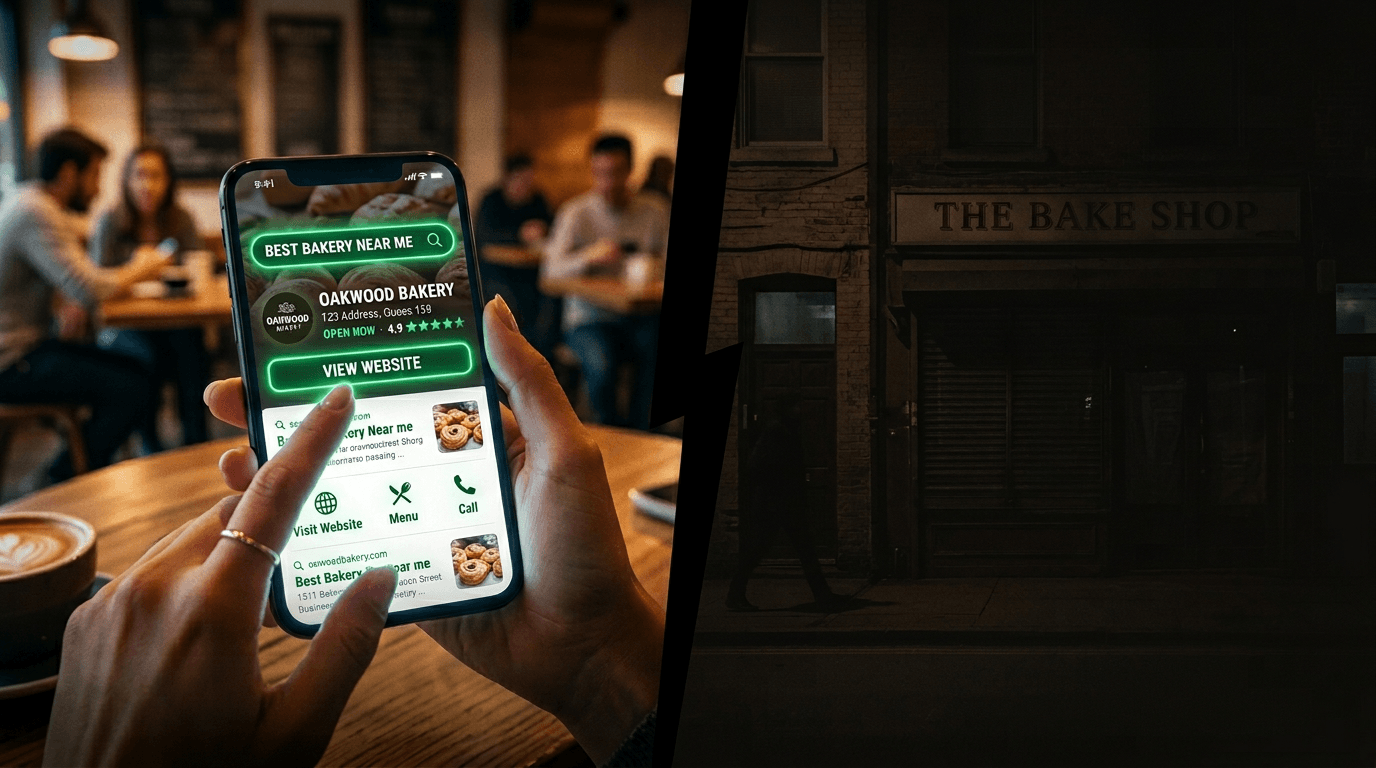
Three results appear. The first has a clean website with a bright "Call Now" button and 47 five-star reviews. The second shows a Facebook page that hasn't been updated since 2023. The third? Nothing but a bare Google Business listing with no website link.
Which plumber gets the $800 emergency call?
Your website isn't a digital brochure gathering dust in cyberspace. It's the trust test your customers run on you before they dial your number — and most decide whether to call you in under three seconds.
Here's what should terrify every business owner: 92% of people who search for local businesses online end up visiting or contacting them. But 56% won't trust a business that doesn't have a professional website. Meanwhile, 27% of U.S. small businesses still operate without any website at all.
That's not just a missed opportunity. That's revenue walking straight to your competitors every single day.
What Your Customers Actually Do Before They Call You
Let me walk you through what happens in those critical five minutes between "I need help" and "I'm calling this business." Understanding this journey changes everything about how you think about your online presence.
The Google moment — it starts with a search
Four out of five consumers search online before making local purchasing decisions. They're not browsing for fun. They have a problem right now — a broken air conditioner on a 95-degree Saturday, a toothache that's keeping them awake, or dinner plans falling apart because the restaurant they wanted is closed.
Urgency is high. Patience is low.
What they see in those search results becomes your first impression: your Google Business Profile, your website (or the glaring absence of one), customer reviews, and your competitors lined up side by side like suspects in a lineup.
The snap judgment — three seconds to win or lose
Users form their first impression of your credibility in 2.6 seconds. This isn't vanity — it's neuroscience. Their brain is making split-second trust calculations before their conscious mind even processes what they're looking at.
63% of this traffic is happening on mobile devices. Your potential customer is standing in their flooded kitchen or sitting in a restaurant parking lot, squinting at a 5.5-inch screen, probably with one bar of cell service.
If your site takes more than three seconds to load, looks like it was built in 2018, or doesn't immediately answer "What can I do here?" — they hit the back button. That bounce represents real money walking away.
The trust checklist they're running (without knowing it)
Every potential customer subconsciously evaluates the same criteria:
Does this look professional? Can I find a phone number without hunting? Are there reviews or proof this business is legitimate? Is this company actually open and active?
They're not consciously thinking through these questions. Their brain is scanning for trust signals at lightning speed, and 80% of consumers prefer buying from businesses with professional websites over those without.
The decision — call, click, or bounce
Users who trust what they see typically decide to contact a business within five minutes of landing on their site. But here's the kicker: websites that load in one second convert 3.5 times better than those taking five seconds.
If you lose them during this window, they don't bookmark you for later. They don't come back tomorrow. They call whoever showed up next in the search results, and that's it.
What a Missing or Bad Website Is Actually Costing You
Let's make the invisible cost visible with actual numbers that matter to your bottom line.
The $17,000 question
Small businesses without websites forfeit an estimated $17,000 in annual revenue. For a local plumber, that's a truck payment. For a dentist, that's new equipment. For a contractor, that's the difference between a growth year and just getting by.
This isn't theoretical money. This is the accumulated value of every potential customer who searched for your services, couldn't find a trustworthy online presence, and called your competitor instead.
Your competitors are already there
73% of U.S. small businesses now have websites — up 39% since 2018. Even more telling: 73% are planning to invest more in their web presence in 2026.
If you don't have a site, or yours looks abandoned, you're not just absent from the competition — you're actively handing customers to businesses that showed up professionally online.
"I have social media — isn't that enough?"
No, and here's why: 64% of small businesses report their website as their primary marketing channel. Social media drives 41% of small business revenue, but it doesn't replace a website — it points people toward one.
A Facebook page is a rented storefront in someone else's mall. The platform controls what your customers see, when they see it, and whether they see it at all. Algorithm changes can kill your reach overnight.
Your website is property you own. It shows up in search results the way social profiles don't. It conveys professional credibility in ways a Facebook page simply can't match.
The 7 Things That Make Customers Bounce (And What to Do Instead)
Here are the specific mistakes that cost you customers, paired with fixes you can implement this week.
1. No clear call to action
70% of small business websites lack a clear call to action on their homepage. Visitors land on your site, scan for three seconds, can't figure out what to do next, and leave.
Fix: Every page needs one obvious next step — "Call Now," "Book Online," "Get a Free Quote." Put it above the fold where people see it immediately. Make the button big, bright, and impossible to miss.
2. Slow loading speed
Remember that conversion stat? One-second load time converts 3.5 times better than five-second load time. Every extra second is customers lost.
Fix: Compress your images, minimize your code, and use fast hosting. Test your speed with Google PageSpeed Insights right now. If you're scoring below 80, you have a problem.
3. Not mobile-friendly
63% of your traffic comes from phones. If your site isn't responsive, the majority of your customers get a broken experience.
Fix: Use mobile-first design principles. Make buttons big enough to tap easily. Ensure text is readable without zooming. Test your site on your own phone — in a parking lot with spotty service, the way your real customers will.
4. Missing or buried contact information
If someone has to hunt for your phone number, they'll call the business that makes it easy instead.
Fix: Put your phone number in the website header. Add a contact page to your main navigation. Enable click-to-call functionality on mobile. Make contacting you the easiest thing on your entire site.
5. No social proof
No reviews, no testimonials, no proof you've successfully served other customers equals no reason to trust you over the next search result.
Fix: Add customer testimonials to your homepage and service pages. Link to your Google reviews. Use specific details: "Fixed our roof in two days — zero leaks through three storms since" beats "Great service!"
6. Outdated or neglected content
A copyright footer reading "© 2021" or a blog last updated two years ago signals your business might be closed or doesn't care about details.
Fix: Update your copyright year. Keep your hours, services, and team information current. If you maintain a blog, post at least quarterly — businesses that blog generate three times more leads than those that don't.
7. Zero SEO basics
68% of small business websites miss basic on-page SEO. Without these fundamentals, Google doesn't know you exist for local searches.
Fix: Add unique title tags to each page, write meta descriptions, use header tags properly, include alt text on images, and mention your city or neighborhood in your copy. These basics help Google connect you with local searches.
The 5-Minute Google Test — Audit Your Business Right Now
Your customers decide whether to call you in about five minutes. This audit takes the same amount of time. Do it right now.
-
Open an incognito browser window on your phone. This shows you what new customers see, not the cached version you're used to.
-
Google your business name. What appears first? Is it your website? Is your Google Business Profile complete and accurate?
-
Click your website link. Count "one-Mississippi, two-Mississippi" while it loads. If you reach three, you have a speed problem.
-
Without scrolling, answer these questions: What does this business do? Where is it located? How do I contact them? If any answer requires hunting, you're losing customers.
-
Look for a clear call to action above the fold. "Call Now," "Book Online," "Get a Free Estimate" — something that tells visitors what to do next.
-
Scroll down and scan for social proof. Reviews, testimonials, customer logos, before-and-after photos — anything that proves you've successfully served other people.
-
Navigate to two other pages. Click your services page and contact page. Do they load quickly? Do images appear? Do links work?
-
Run a local search. Google "[your service] + [your city]" like "emergency plumber Austin" or "dentist downtown Seattle." Do you appear on the first page?
-
Check desktop too. Open your site on a computer. Is the experience consistent with mobile?
-
Score yourself honestly. For every "no" answer, that's a leak in your pipeline where customers are dripping out.
If you scored 8 out of 10 or higher, you're ahead of most local businesses. If not, every day you wait is another customer calling your competitor instead.
What a Small Business Website Actually Needs (And What It Doesn't)
Forget the "fancy website" myth. Here's what actually matters to customers making buying decisions.
The must-haves
Your homepage must answer "Who are you, what do you do, and why should I trust you?" in three seconds or less. Use a clear headline, professional photos, and obvious contact information.
Create service pages structured as problem → solution → proof. Your contact page needs phone, email, address, map, and a simple form. Your about page should include real photos and human stories — people hire people, not logos.
Mobile-responsive design isn't optional anymore. Neither is an SSL certificate (the HTTPS padlock icon) — browsers warn visitors that sites without them are "not secure."
Link your Google Business Profile and keep all information consistent across platforms. Name, address, and phone number discrepancies confuse both customers and search engines.
The nice-to-haves (when you're ready)
Online booking or scheduling systems can increase revenue by 23% for service businesses. A regularly updated blog helps with SEO and authority building. Chat widgets handle quick questions when you're busy.
Case studies and project galleries work well for contractors, agencies, and professional services. These build credibility but aren't essential for getting started.
What you don't need
Skip fancy animations that slow everything down. Avoid homepage sliders — visitors ignore them, and they hurt loading speed. Use one strong image with a compelling headline instead.
Never publish "under construction" pages. If content isn't ready, don't put it online yet.
Ditch stock photos of generic businesspeople shaking hands. Use real photos of your team, your work, and your location. Authenticity beats perfection every time.
The Bottom Line — Your Website Is Your Hardest-Working Employee
Your website works 24 hours a day, seven days a week. It doesn't call in sick, take vacations, or need coffee breaks. It answers the same questions repeatedly without getting tired or impatient.
Businesses with professional websites grow revenue 2.8 times faster and are 2.8 times more likely to expand their operations. The average small business website generates $2.88 in revenue per visitor, and 46% of small business sites receive between 1,001 and 15,000 monthly visitors.
That math adds up fast when you consider the alternative: your customers are Googling you right now. The only question is what they're finding when they do.
Every search without a professional result is money walking to a competitor who showed up online. Every slow-loading page is a customer lost. Every missing phone number is a call that goes elsewhere.
Your website isn't a nice-to-have anymore. It's the foundation of customer trust in 2026. The businesses that understand this — and act on it — will capture the revenue from those that don't.
The pipe is still bursting. The customer is still searching. The only question left is whether they'll find you ready to help or hand that emergency call to someone who was.