No Website? You're Invisible to Local Customers
Your potential customer's toilet is overflowing at 8 PM on a Tuesday. They grab their phone and search "emergency plumber near me." Three competitors appear ...
Your potential customer's toilet is overflowing at 8 PM on a Tuesday. They grab their phone and search "emergency plumber near me." Three competitors appear with professional websites, customer reviews, and one-click calling. You don't.
That customer calls the first result. Job gone. Revenue gone. Relationship gone.
This exact scenario plays out dozens of times every day across every local business category. 27% of U.S. small businesses still don't have a website — roughly 8.8 million businesses choosing to be invisible when customers need them most.
If you're one of them, this article is going to be uncomfortable. Good.
You're not "off the grid." You're off the map
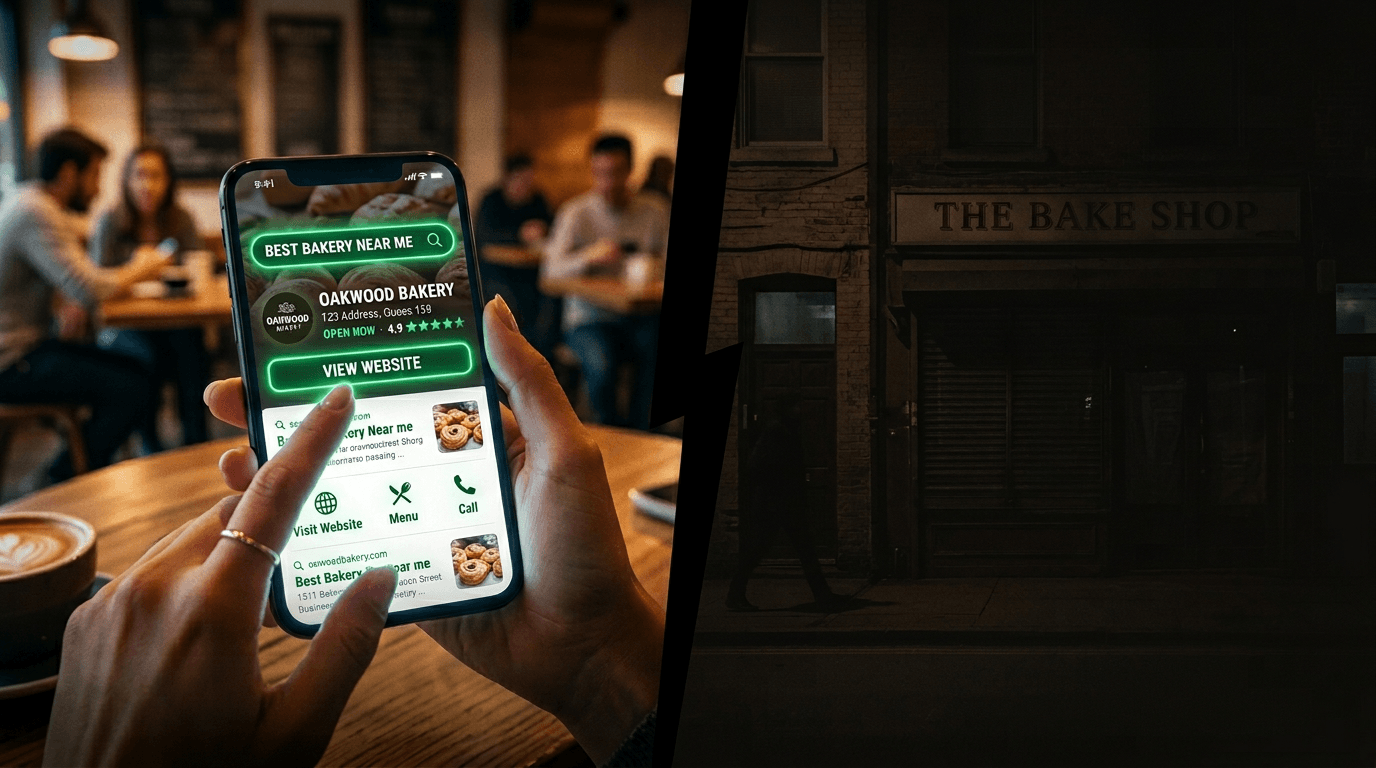
Here's what actually happens when someone searches for your services: Google serves up local results with websites, photos, hours, and reviews. Your competitors look professional and established. You look like you don't exist.
Because to that customer, you don't.
The stakes aren't abstract. 99% of consumers research local businesses online before visiting. 46% of all Google searches have local intent. When someone needs what you sell, they're not flipping through the Yellow Pages or asking neighbors. They're searching on their phone, and they're deciding who to call within seconds.
Every day you operate without a website, you're paying what I call "The Invisibility Tax" — the revenue that walks past your door because customers never knew you existed.
The numbers you can't argue with
How many customers are searching for you right now
The local search market isn't shrinking. It's exploding:
| Statistic | Impact | |-----------|--------| | 99% of consumers research local businesses online | Your customers expect to find you digitally | | 46% of Google searches have local intent | Nearly half of all searches are looking for local businesses | | 80% of consumers use search engines weekly for local businesses | This is habitual behavior, not occasional | | 76% of smartphone local searches result in store visits within 24 hours | High-intent customers ready to buy | | 28% of local searches result in purchases | These aren't browsers — they're buyers | | 56% of consumers distrust businesses without websites | No website = credibility problem |
The pattern is clear: customers search locally, they expect professional online presence, and they buy quickly when they find it.
What it costs you to be missing
Businesses without websites forfeit an average of $17,000 in annual revenue. That breaks down to roughly $47 bleeding out every single day.
But the gap widens over time. Websites boost revenue growth 40% faster, and businesses with sites grow 2.8x more than those without, according to a Google/Deloitte study of over 4,500 businesses. While you're standing still, competitors with websites are accelerating away.
The direct impact is measurable too. 61% of small business owners with websites report direct sales increases. The average revenue per website visitor sits at $2.88 — and that's just immediate conversions, not the long-term relationship value.
Every visitor who can't find your website represents lost revenue. Every competitor with a professional site captures customers who should have been yours.
"But I have a Facebook page..."
Why social media profiles are not a substitute
21% of businesses without websites say they rely on social media instead. I get the logic. Facebook is free, easy to set up, and your customers are already there.
But here's what you're missing: you don't own Facebook. Mark Zuckerberg does.
Organic reach on Facebook hovers around 2-5% of your followers. Post to 1,000 followers, maybe 50 see it. Facebook's algorithm decides who gets your message, when they see it, and whether it appears at all. That's not marketing — that's hoping.
More importantly, Facebook pages can't rank in Google local search results. When someone searches "dentist near me," Google doesn't surface Facebook pages. It surfaces websites. You're completely invisible in the search that matters most.
56% of consumers distrust a business that doesn't have a website. A Facebook page doesn't bridge that credibility gap. If anything, it reinforces the perception that you're not serious about business.
Social profiles lack the structured data, local SEO signals, and customized customer journey that websites provide. You can't optimize a Facebook page for "emergency plumber downtown Seattle" the way you can optimize a website.
Why a Google Business Profile alone isn't enough either
Google Business Profile is essential. It's also insufficient.
A verified GBP drives approximately 105 website visits per month — but only if there's a website to drive traffic to. Without that destination, you're sending interested customers to a dead end.
Complete Google profiles boost trust 2.7x, and "complete" includes having a website URL. 92% of local featured snippets go to mobile-optimized websites, not standalone GBP listings.
Your Google Business Profile works best as a signpost pointing to your website. Without the website, you've built half a bridge.
The three excuses (and why they're wrong)
"My business is too small to need a website"
35% of business owners without websites believe this. The logic feels sound: "I'm just one person, I don't need all that complexity."
But size doesn't determine customer behavior. A solo landscaper's potential customers search "landscaping services near me" the same way they'd search for a Fortune 500 company. 89% of businesses with 11-100 employees have websites, and 69% call it their top lead source.
Your competitors have websites. When customers compare options, they choose whoever shows up professional and established. A one-page site with your services, service area, photos, and phone number instantly puts you on equal footing with larger competitors.
Being small is exactly why you need every advantage you can get.
"It's too expensive"
26% cite cost as the primary barrier. This made sense in 2006 when custom websites cost $5,000+ and required developers for every update.
In 2026, modern website builders cost $15-50 per month. AI builders have cut traditional development costs by 80-90%. A basic, effective local business website can be live within an afternoon for under $200 annually.
Let's do the math: $200 per year vs. $17,000 per year in lost revenue. The return on investment isn't even close.
The question isn't whether you can afford a website. It's whether you can afford to keep operating without one.
"My customers already know how to find me"
27% say a website is "not relevant" to their business. This assumes your only customers are existing customers.
But 96% of consumers discover local businesses through online search. Even word-of-mouth referrals Google you before they call. Your best customer tells their neighbor about your great service, and that neighbor immediately searches for your business name to find your number, read reviews, and verify you're legitimate.
If they find nothing, they'll search for your competitors instead.
You're not just missing new customers — you're losing referrals from existing ones.
What happens when someone Googles you (and finds nothing)
Walk through the typical customer journey:
- Customer has an urgent need ("My AC stopped working")
- Searches "AC repair near me" on their phone
- Google displays the local 3-pack with business listings
- Customer clicks the top result with a professional website
- Website shows services, reviews, coverage area, and prominent phone number
- Customer calls immediately
You don't exist in steps 3-5. While that customer is evaluating options, you're completely invisible.
Now replay it with even a basic website:
- You appear in local search results
- You look legitimate and established
- You get the call
The difference between existing and not existing in that critical moment determines whether you get the business.
Your customers Google you before they call you — and if they find nothing, they call someone else.
The minimum viable website (what you actually need)
You don't need a perfect site. You need a live one.
Here's what actually moves the needle for local businesses:
-
Your name, address, and phone number — Make it crawlable by Google and consistent everywhere online
-
What you do and where you do it — Clear service descriptions with location keywords that match how customers search
-
Mobile-friendly design — 4.8 billion people use mobile devices in 2026, and Google indexes mobile-first
-
One clear call to action — 70% of small business websites lack a clear CTA. "Call now," "Get a quote," or "Book online." Pick one and make it impossible to miss.
-
Social proof — Even 3-5 customer testimonials or reviews. You don't need 500+ reviews like top competitors, but any social proof beats zero.
You can have all five elements live by this weekend. The technology exists, the templates work, and the cost is negligible.
Even a one-page website can transform your local visibility by establishing your digital presence and giving Google something to index and rank.
The compounding cost of waiting
Every day without a website costs approximately $47 in lost revenue. Every month costs $1,417. Every year you've been "getting around to it" has cost $17,000+.
Meanwhile, competitors with websites grow 2.8x faster. The gap doesn't stay static — it widens.
73% of small businesses plan to invest in their website infrastructure, with 43% targeting 2026 upgrades. Your competitors aren't standing still. They're investing in the digital presence that captures customers while you remain invisible.
The best time to launch a website was five years ago. The second-best time is this week.
FAQ: Common questions about small business websites
Do I really need a website if I have a Google Business Profile? Yes. Your GBP drives traffic to your website — without that destination, you're sending interested customers nowhere. Complete profiles with websites boost trust 2.7x compared to incomplete ones.
How much does a small business website cost? Modern website builders cost $15-50 monthly. A basic local business site runs under $200 annually — compared to $17,000 in average annual revenue loss without one.
Can a one-page website actually help my business? Absolutely. A single page with your services, contact info, and location can rank in local search results and establish credibility. Perfect is the enemy of done.
How quickly can I get a website up and running? With modern builders, you can have a functional local business website live within an afternoon. The technology has simplified dramatically since 2020.
Will a website help me show up in local search results? Yes. 92% of local featured snippets go to mobile-optimized websites. Google needs content to crawl and index — a website provides exactly that.
Every day you operate without a website, competitors with professional online presence capture customers who searched for exactly what you provide. The invisibility tax compounds daily.
The solution isn't complex or expensive. It's urgent.
Stop paying $47 a day to remain invisible. Your customers are searching for you right now — make sure they can find you.