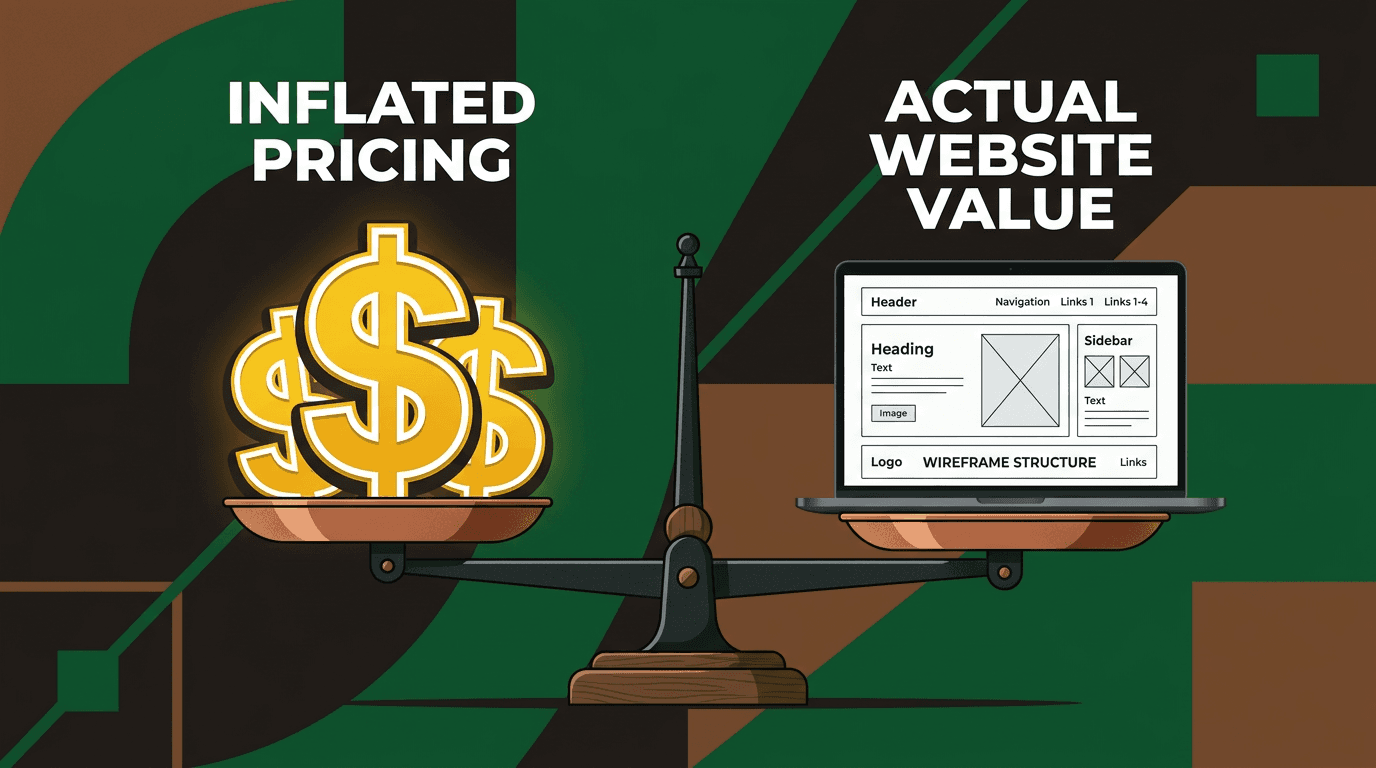
Small Business Web Design Pricing Is Broken: The $5,000 Website That Made $0
Here's the uncomfortable truth about web design pricing: you're not comparing apples to apples. You're comparing apples to oranges to mystery fruit that migh...

Here's the uncomfortable truth about web design pricing: you're not comparing apples to apples. You're comparing apples to oranges to mystery fruit that might poison your business.
The numbers are all over the map because the market itself is fundamentally broken. No standards. No accountability. No shared understanding of what you're actually buying.
Sarah runs a boutique bakery in Portland. Business was good, but she needed a professional website to compete with the bigger chains moving into her neighborhood.
She hired a well-reviewed local agency. Paid $5,200 upfront. Got a gorgeous site with stunning photos of her pastries and a clean, modern design that looked perfect on her laptop.
Six months later? Zero leads from the website. Not one.
The site had no SEO foundation — Google couldn't find it. No clear call-to-action — visitors didn't know how to place orders. No mobile optimization — it looked broken on phones. No maintenance plan — it was already running slow and showing security warnings.
Sarah paid for a website. She got a digital business card that nobody could find.
This happens every day. Here's why.
Why the cost for professional website design varies wildly
No industry standardization. Unlike plumbing or accounting, web design has no licensing requirements, no standard scope definitions, no professional certifications that mean anything. A "$5,000 website" from one provider bears zero resemblance to a "$5,000 website" from another.
Information asymmetry. The seller knows exactly how long each task takes and which tools make it faster. You don't. They know which features actually drive results and which are just pretty. You don't. This knowledge gap lets them price however they want.
Misaligned incentives. Agencies profit from complexity and scope creep. DIY platforms profit from your monthly subscription whether your site converts or not. Nobody gets paid based on your website's actual performance.
"Custom" means nothing. A $2,000 freelancer site built on a premium WordPress theme and a $12,000 agency site built from scratch are both called "custom." The word has been diluted to meaninglessness.
Here's what matters: 75% of customers judge your credibility by your website design. So you can't afford to get this wrong. But the broken pricing model makes it nearly impossible to get it right.
Where the money actually goes (a $5,000 proposal, torn apart)
Let's dissect a real-world proposal. This is what a typical small business pays $5,000 for:
Discovery & strategy (~$500–$1,000)
What it includes: Competitor review, sitemap planning, brand questionnaire, content audit.
Where value hides: Good agencies earn their entire fee in this phase. They figure out what your customers actually want and how your site should deliver it. Skip discovery and you'll build the wrong site beautifully.
Red flag: If there's no discovery phase, you're buying a template with your logo slapped on it.
Design (~$1,000–$2,000)
What it includes: Homepage mockup, 1-2 revision rounds, responsive layouts for tablet and mobile.
Where margin hides: Many agencies start with premium templates and customize from there. Nothing wrong with that approach — but you shouldn't pay full custom prices for it.
Reality check: Design is the most visible cost but rarely the most valuable. Pretty doesn't pay the bills.
Development & build (~$1,000–$2,000)
What it includes: CMS setup (WordPress, Webflow, etc.), contact forms, basic integrations, mobile optimization.
Where bloat creeps in: Plugin stacking, unnecessary custom code, features you asked for but don't actually need. Development costs can balloon quickly when scope isn't clearly defined.
Content (~$0–$500)
Here's the biggest lie in web design: "We'll need you to provide the copy."
Most proposals exclude copywriting entirely. Then your site launches with placeholder text or whatever you typed at 11 PM after a long day running your actual business.
Content is where conversions happen. Budget for professional copy or watch your investment disappear.
QA, launch & handoff (~$250–$500)
What it includes: Testing across devices, speed optimization, analytics setup, basic training on updating the site.
Red flag: If the proposal doesn't include a detailed post-launch checklist, ask for one. This is where corners get cut.
The line items that should be there (but usually aren't)
- SEO foundation: Title tags, meta descriptions, site speed optimization, schema markup
- Ongoing maintenance plan: With defined scope and response times
- Performance baseline: What does "success" look like in 90 days?
Most proposals ignore these entirely. Then they charge you extra when your site doesn't work.
The three pricing models (honestly compared)
Project-based pricing
How it works: Flat fee for a defined scope. Pay $5,000, get a website.
Pros: Predictable total cost. Clear deliverable. No hourly meter running.
Cons: Scope creep fights. "Finished" site gets no updates. Provider incentivized to build fast, not build right.
Best for: Established businesses with clear requirements and in-house resources to handle ongoing updates.
Hourly pricing
How it works: $75-$150/hour (U.S. average for 2026), billed against an estimate.
Pros: Pay only for work done. Flexibility to add or remove features.
Cons: Unpredictable final cost. Incentivizes slow work. You're watching a meter run during every phone call.
Best for: Very specific, small-scope tasks. Not full website builds.
Subscription/productized pricing
How it works: $200-$4,490/month bundles covering design, updates, hosting, and maintenance.
Pros: No massive upfront cost. Continuous improvement. Provider must keep you happy to keep getting paid.
Cons: Long-term cost can exceed project pricing. Quality varies wildly. Potential vendor lock-in.
Best for: Businesses that need to launch fast, iterate often, or lack upfront capital.
The subscription model has grown significantly in 2025-2026 as a direct response to the broken traditional pricing model.
What web design cost for small business should actually be (based on your business, not generic ranges)
| Business Stage | Revenue | Budget Range | Priority | |---------------|---------|--------------|----------| | Pre-revenue | $0 | $0-$100/month | Get online fast | | Early-stage | Under $250K | $1,500-$5,000 | Professional credibility | | Established | $250K-$1M+ | $5,000-$12,000 | Competitive advantage | | E-commerce/Complex | Varies | $10,000-$50,000+ | Revenue generation |
Pre-revenue/side hustle ($0–$100/month or $0–$500 upfront)
Use a DIY builder: Wix, Squarespace, or Carrd. Get online fast. Don't overthink it.
Priority: One clear call-to-action, mobile-friendly design, Google Business Profile connected.
Early-stage/under $250K revenue ($1,500–$5,000 or $200–$500/month)
Hire a freelancer or use a productized service. Clean, conversion-focused 5-8 page site.
Priority: SEO basics, fast load times, professional copywriting, lead capture system.
Established/$250K–$1M+ revenue ($5,000–$12,000 or $500–$1,500/month)
Work with a boutique agency or senior freelancer. Strategy-led, performance-optimized approach.
Priority: Brand differentiation, content strategy, integrations, analytics, maintenance plan.
E-commerce/complex needs ($10,000–$50,000+)
Partner with a specialized agency or platform expert (Shopify, WooCommerce).
Priority: Conversion funnel optimization, product photography, shipping/tax integrations, security.
The ROI math nobody shows you
Every competitor talks about website costs. None talk about website returns.
Here's the simple formula: (Monthly leads from website × Close rate × Average job value) - Monthly website cost = Website ROI
Real example: A landscaper invests $4,000 in a professional website with SEO. The site generates 20 qualified leads per month. He closes 25% at $2,000 average project value.
Monthly return: 20 leads × 25% × $2,000 = $10,000 Payback period: Less than two weeks.
Contrast with Sarah's bakery: $5,200 investment, zero leads, infinite payback period.
The difference? The landscaper's site was built with ROI in mind. Sarah's was built to look pretty.
Studies show that polished UX can boost conversions 200-400%. But only if you measure and optimize for conversions, not just aesthetics.
Your website isn't an expense. It's an investment with a calculable return — but only if it's built with ROI in mind.
How to spot an inflated quote (7 red flags)
-
No discovery or strategy phase — just "pick a template" What to do instead: Demand a strategy session before any design work starts
-
Vague line items ("development: $3,000") with no task breakdown What to do instead: Ask for specific deliverables and time estimates
-
No mention of mobile optimization or page speed What to do instead: Require mobile-first design and speed benchmarks
-
Content listed as "client-provided" with no copywriting support What to do instead: Budget for professional copy or demand content guidance
-
No ongoing maintenance, hosting, or support plan included What to do instead: Get maintenance costs upfront, not as surprise bills later
-
Timeline is undefined or unrealistically short/long What to do instead: Expect 4-8 weeks for most small business sites
-
They can't show you results from a similar past project What to do instead: Ask for case studies with specific metrics, not just pretty portfolios
How to negotiate a web design proposal without getting burned
Get three quotes minimum. Not to find the cheapest option, but to understand what the market actually offers. Pricing varies dramatically based on provider type and scope.
Ask what's NOT included. This reveals hidden costs faster than anything else. Maintenance, content updates, plugin licenses, SSL certificates — these "small" costs add up to thousands per year.
Define success metrics upfront. "I want 30 qualified leads per month within 6 months" gives you something measurable to hold them accountable for.
Start with an MVP. Launch a lean site that covers the basics, then invest more based on what the data tells you matters.
Own your domain, hosting, and content. Never let a vendor hold your site hostage. You should be able to leave at any time with all your assets.
The bottom line — stop comparing prices, start comparing value
The small business web design market is broken because it has no standards, buyers have no framework, and sellers have no accountability for results.
Your website should be judged by what it returns to your business, not what it costs to build.
Website development costs continue rising, but that's not the real problem. The real problem is buying the wrong solution at any price.
Stop asking "How much does a website cost?" Start asking "How much revenue can this website generate?"
The providers who can answer that second question are the ones worth paying.
Ready to get a website that actually works for your business? Skip the broken traditional model. We build ROI-focused websites with transparent pricing, clear timelines, and guaranteed results. No surprises, no scope creep, no pretty sites that make $0.
Get a free website audit and pricing breakdown for your business in 48 hours.
Frequently asked questions
How much should a small business website cost? Between $1,500-$12,000 depending on your business revenue and complexity needs. Pre-revenue businesses can start with $100/month DIY solutions, while established businesses ($250K+ revenue) should budget $5,000-$12,000 for professional development.
Why is web design so expensive? Web design pricing varies wildly due to lack of industry standards, information asymmetry between buyers and sellers, and misaligned incentives. "Custom" work can range from template modifications to completely original development, but both get labeled the same way.
What's included in a typical web design package? Most packages include discovery/strategy, visual design, development, basic SEO setup, and launch support. However, ongoing maintenance, professional copywriting, and performance optimization are often excluded and cost extra.
How can I avoid getting ripped off on web design? Get three quotes minimum, ask what's NOT included in each proposal, demand specific deliverables rather than vague line items, and require case studies showing actual business results from similar projects.
Is subscription web design pricing worth it? Subscription models ($200-$500/month) work well for businesses needing ongoing updates, lacking upfront capital, or wanting aligned incentives with their provider. Total long-term cost may exceed project pricing, but you get continuous improvement and support.