Web Design Pricing for Small Businesses Is Broken (Here's How to Fix It)
Picture this: You own a bakery and decide you need a website. You get three quotes for what sounds like the same five-page site. The first designer says $1,2...

Picture this: You own a bakery and decide you need a website. You get three quotes for what sounds like the same five-page site. The first designer says $1,200. The second agency quotes $6,500. The third consultant wants $14,000. All three claim they're giving you a "professional website."
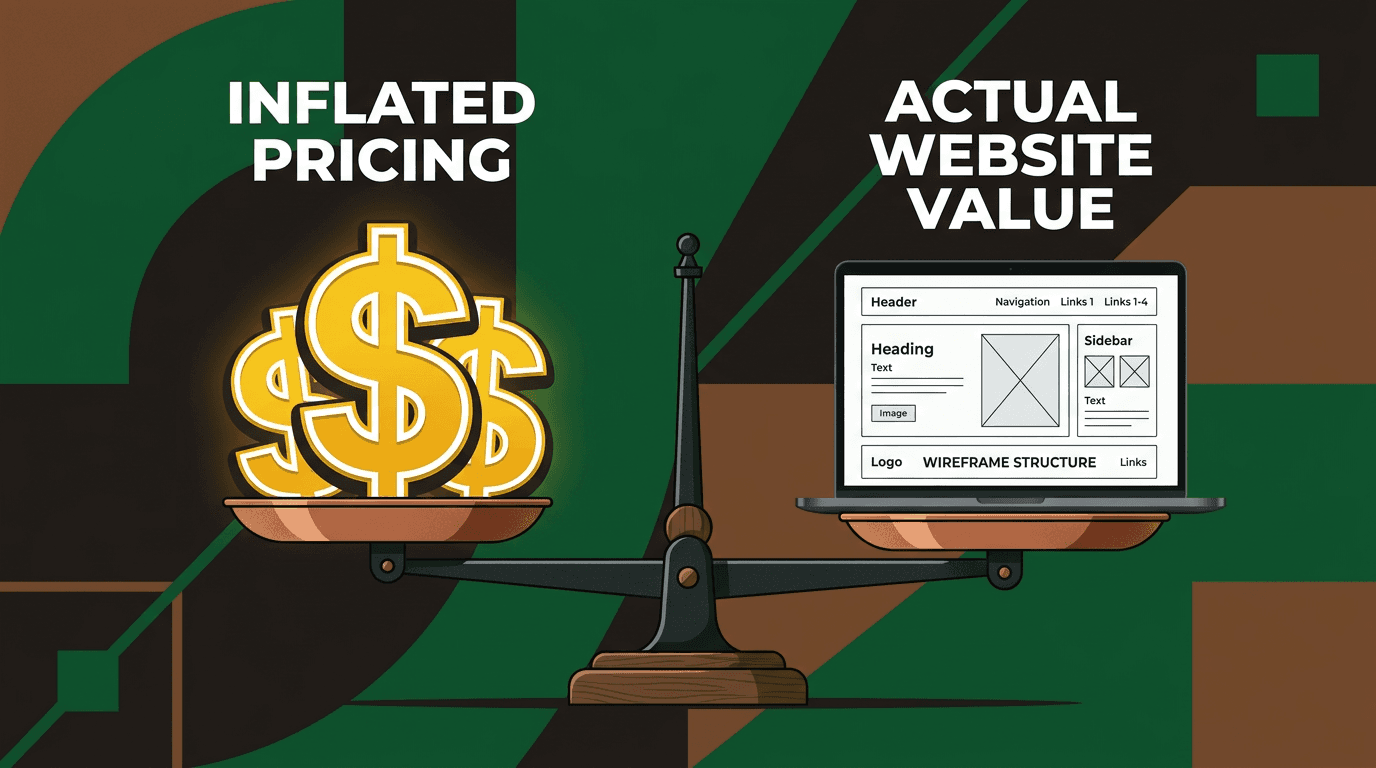
You're not losing your mind. The pricing isn't confusing because web design is rocket science — it's confusing because confusion makes money.
Professional website design prices for small businesses range from $1,500 to $15,000 upfront, but the real problem isn't the range — it's that nobody explains what you're actually buying. Most web design pricing deliberately obscures what's included, what costs extra, and what you'll pay over time. This opacity benefits providers, not you.
Here's what's really happening: when you can't compare apples to apples, you can't shop smart. When scope is vague, extras pile up. When there's no standard for what "professional" means, anyone can charge professional rates for amateur work.
By the end of this article, you'll know exactly which pricing model fits your business and which ones to run from. No more spreadsheets of meaningless ranges. No more "it depends" non-answers.
You're not confused — the pricing is designed to confuse you
The web design industry thrives on information asymmetry. Most small business owners don't know the difference between custom coding and template customization. They don't know that "mobile responsive" is standard, not premium. They don't know that basic SEO setup takes 30 minutes, not 30 hours.
This knowledge gap gets expensive fast. Agencies routinely charge $8,000 for lightly modified WordPress themes that cost $60. Freelancers bill separate line items for features that come built-in. Subscription models hide true costs behind monthly payments that add up to more than traditional builds.
The confusion isn't accidental. When you can't comparison shop effectively, providers can charge whatever the market will bear. When deliverables are vague, scope creep becomes profitable. When there's no accountability for results, you pay the same whether your site brings in customers or collects digital dust.
But you don't have to accept broken pricing. Once you understand the four models and their real costs, you can make smart decisions.
The four pricing models (and what they actually mean for you)
Hourly pricing — you're paying for someone else's inefficiency
Here's how hourly billing works: designers quote $50-$150 per hour (or $15-$50 if you go offshore), estimate the project will take 40 hours, then bill you for actual time spent.
The problem? This model punishes you for their inefficiency. A designer who takes 60 hours to do 40 hours of work earns 50% more. There's zero incentive to work faster or smarter. Scope creep becomes a feature, not a bug — every revision request is another billable hour.
Most small business websites end up costing 25-50% more than the initial estimate when billed hourly. That $3,000 quote becomes $4,500 real quick.
When hourly makes sense: Very small, clearly defined tasks like adding a contact form to an existing site or fixing a specific bug. For full website builds? Almost never.
Flat-rate pricing — better, but watch the fine print
Project-based pricing gives you a fixed cost upfront. Freelancers typically charge $1,500-$8,000 for small business sites. Agencies want $6,000-$15,000 for similar work.
The trap lies in what's included versus what costs extra. That $4,000 quote might exclude content writing ($1,200), professional photos ($800), more than two rounds of revisions ($150 each), mobile optimization ($500), and basic SEO setup ($1,000).
Your $4,000 website just became $7,650.
The key question to ask: "What exactly do I get for this price, and what costs extra?" Get it in writing. If they can't give you a detailed scope, keep shopping.
Monthly pricing — the model most people don't know about
Website-as-a-service works like this: you pay $150-$350 per month for design, hosting, maintenance, and ongoing edits. No big upfront cost. Cancel anytime.
This model aligns incentives properly. Providers only get paid if you stay happy. Sites that don't work get canceled. Quality tends to be more consistent because reputation matters more than one-time sales.
The honest downsides: you don't own the site files, long-term costs can exceed one-time builds, and you're locked into their platform. But for many small businesses, predictable monthly costs beat surprise invoices.
Template-based pricing — the $8,000 template problem
Here's the industry's dirtiest secret: many agencies charge custom prices for template work. They'll quote $5,000-$15,000 for a "custom design" that's actually a $60 WordPress theme with your logo swapped in.
This isn't inherently evil. Good templates can look professional and work great. But you shouldn't pay custom rates for template work.
How to spot it: Ask what platform they're building on. Ask to see the base theme. Ask what's truly custom-coded versus customized. If they get evasive, you have your answer.
What a small business website should cost (3-year total cost of ownership)
Upfront price tells you nothing. You need to think in total cost over three years — including hosting, maintenance, updates, and eventual redesigns.
Here's what each model actually costs when you add it all up:
| Cost Component | DIY Builder | Freelance (One-Time) | Agency (One-Time) | Subscription Model | |---|---|---|---|---| | Upfront build | $100–$500 | $1,500–$5,000 | $6,000–$15,000 | $0–$500 | | Hosting (3 yrs) | $430–$1,800 | $360–$900 | $360–$2,250 | Included | | Maintenance/updates (3 yrs) | DIY (your time) | $600–$3,600 | $1,800–$9,000 | Included | | Redesign (Year 3) | $0–$500 | $1,000–$3,000 | $3,000–$8,000 | Included/rolling | | 3-Year Total | $530–$2,800 | $3,460–$12,500 | $11,160–$34,250 | $5,400–$12,600 |
The subscription model often lands in the same range as freelance work, but with ongoing support and no surprise invoices. The agency model becomes dramatically more expensive when you factor in their ongoing fees and redesign cycles.
Don't forget opportunity cost. That "cheap" DIY option costs you 20-40 hours of your time — time you could spend running your business.
The red flags checklist — how to spot broken pricing before you sign
Print this list and bring it to your next sales call:
• They won't tell you what platform they're using. If it's proprietary, you can't take your site elsewhere.
• They charge separately for mobile responsiveness. This has been standard since 2015.
• They quote "SEO setup" as a $1,000+ line item with no specific deliverables listed.
• They guarantee first-page Google rankings. No legitimate provider can promise this.
• Their "custom design" looks suspiciously like a ThemeForest template. Ask to see the original theme.
• The proposal has no revision limit and no scope definition. This guarantees cost overruns.
• They charge for stock photos from free libraries. Unsplash and Pexels don't cost $50 per image.
• The contract auto-renews with price increases buried in paragraph 14. Read the fine print.
• They can't show examples of sites for businesses like yours. Portfolio mismatch means learning curve on your dime.
• They build on platforms you can't access or edit. You should own your content and have export options.
Which pricing model is right for your business?
Stop guessing. Here's how to choose based on where your business actually is:
You just need to exist online (go DIY or ultra-basic freelance)
Your profile: Solopreneur, side hustle, brand-new business testing an idea, revenue under $50K annually.
Budget target: Under $2,000 upfront or under $75/month subscription.
What you need: 1-5 pages, contact form, Google Business Profile integration, mobile-friendly design, fast loading speeds. That's it.
Squarespace or Wix can handle this. So can a basic freelancer who specializes in simple business sites. Don't overthink it.
You need a website that brings in customers (go freelance or subscription)
Your profile: Established local business, service provider, revenue $50K-$500K, website needs to generate leads.
Budget target: $2,000-$6,000 upfront (freelance) or $200-$350/month (subscription).
What you need: 5-15 pages, local SEO foundations, clear calls to action, booking or contact integration, professional photography support, content strategy.
This is where most small businesses should focus their energy. Your website becomes a sales tool, not just a digital business card.
You need e-commerce or complex functionality (go boutique agency or specialist)
Your profile: Product-based business, multi-location operation, revenue $500K+, need custom features.
Budget target: $8,000-$15,000 upfront plus $200-$500/month maintenance.
What you need: Custom functionality, payment processing, inventory management, user accounts, integrations with existing systems, scalability planning.
At this level, the investment makes sense because the return justifies it.
Stop comparing prices — start comparing value
Here's the question that matters: what return will this website generate for your business?
Simple math: if your site generates 10 qualified leads per month and you close 3 of them at $500 average value, that's $1,500 monthly revenue. A $4,000 website pays for itself in under 3 months.
Most small businesses see their website investment return within 6-12 months when they focus on lead generation instead of just "looking professional."
If a web designer can't talk about your business goals — only their deliverables — that's a red flag. The right provider asks about your customers, your sales process, and your growth plans. They price based on value delivered, not hours logged.
The pricing is broken because the industry got disconnected from results. You don't have to accept that trade-off.
Your next steps
Web design pricing doesn't have to be a mystery. You now know the four models, their real costs, and which one fits your business stage.
Before you sign anything, run it through the red flags checklist. Calculate the 3-year total cost of ownership. Ask hard questions about what's included and what costs extra.
Most importantly, choose a provider who talks about your business success, not just website features. The right pricing model aligns their incentives with your results.
Stop accepting broken pricing. Your business deserves better than confusion and surprise invoices. Now you have the tools to demand transparency and make smart decisions.
Frequently Asked Questions
How much should a small business pay for a professional website?
Most small businesses should budget $2,000-$6,000 for a professional website that generates leads, or $200-$350/month for a subscription model. Factor in 3-year total costs including hosting, maintenance, and updates — not just the upfront price.
What's the difference between template and custom website pricing?
Custom websites involve original coding and design work, justifying $8,000-$15,000+ costs. Template-based sites use pre-built themes with customization, fairly priced at $1,500-$5,000. The problem is agencies charging custom prices ($8,000+) for template work.
Should I pay hourly or flat-rate for web design?
Flat-rate pricing protects you from scope creep and inefficiency. Hourly billing incentivizes slow work and often costs 25-50% more than estimates. Only use hourly for small, specific tasks like adding single features to existing sites.
Are website subscription models worth it?
Subscription pricing ($200-$350/month) works well if you want predictable costs and ongoing support. Over 3 years, total cost often matches freelance pricing but includes maintenance and hosting. The tradeoff is you don't own the site files.
What website features should be included in the base price?
Mobile responsiveness, basic SEO setup, SSL certificate, contact forms, and social media integration should be standard. Separately charging for these basics in 2026 is a red flag that the provider is padding costs.