Your Dentist Website Doesn't Need 20 Pages
Here's what happened to Dr. Sarah Chen. Her agency delivered a beautiful 20-page website in early 2025. Individual pages for teeth whitening, veneers, crowns...
Here's what happened to Dr. Sarah Chen. Her agency delivered a beautiful 20-page website in early 2025. Individual pages for teeth whitening, veneers, crowns, bridges, implants, Invisalign, root canals, and pediatric cleanings. A media page with one press mention from 2023. A blog with three posts that stopped after launch. Separate bio pages for each of her four team members.
Six months later, half the content was stale. The procedure pages had outdated pricing. The blog made her practice look abandoned. Her site took 8 seconds to load on mobile. Despite ranking for "dentist near me," she was booking fewer appointments than her competitor down the street with a simple 5-page site.
You're facing the same problem. You've been sold a website you can't maintain.
What patients actually want from a dentist website isn't a digital magazine. They want to book an appointment fast. Your 20-page site is standing in their way.
You've been sold a website you can't maintain
That beautiful site your agency delivered comes with a hidden cost: your time. Every page needs quarterly updates. Twenty pages means 80 content tasks per year. When did you last review your "Advanced Periodontal Therapy" page? What about that team bio for the hygienist who left eight months ago?
The common offenders pile up fast. Individual pages for every micro-procedure eat up your content bandwidth. You don't need separate pages for teeth whitening, professional cleaning, deep cleaning, and preventive care. Your patients aren't searching for "professional dental cleaning in Riverside vs preventive care in Riverside." They're searching for "dentist near me" and "book dental appointment."
That media page with one mention from the local paper in 2025? Nobody visits it. Your Google Analytics will show 0-2 monthly pageviews. Same for individual team member pages, especially if you have high hygienist turnover.
The abandoned blog is worse than no blog. Three posts from 2025 with no updates signal neglect. Studies show that 69% of patients research online before booking, and stale content destroys trust faster than missing content.
Here's the math that matters: You're a dentist running a small business. You don't have a content team. Those 20 pages aren't getting maintained, and every stale page actively hurts your credibility.
Why fewer pages actually rank better for local search
The "more pages = better SEO" logic died around 2019. Google's algorithm prioritizes relevance and user experience over page count, especially for local searches.
Google rewards relevance, not volume
For local dental searches, Google cares about three ranking factors: your Google Business Profile optimization, patient reviews, and site quality signals. Page count isn't on the list.
When someone searches "dentist near me" or "dental implants [city]," Google looks at proximity, reviews, and whether your site answers their question quickly. A lean, fast-loading site with clear service descriptions beats a bloated site where visitors get lost three clicks deep.
Research shows that over 60% of healthcare searches happen on mobile, where users want answers in seconds, not exploration. Thin, outdated pages send negative quality signals. Content decay equals trust erosion in Google's eyes.
Speed kills (your competitors, not you)
Every additional page adds weight. More images, scripts, plugins, and crawl demands. Conversion rates drop 7% for every additional second of load time, and most dental sites convert at just 2-5%. The practices hitting 30%+ conversion rates? They have lean, fast sites.
A 5-page site on a clean platform loads faster than a 20-page WordPress installation stuffed with procedure page plugins. Google's Core Web Vitals directly impact rankings, and fewer pages score better by default.
Crawl budget and consolidation
Google spends limited time crawling your site. Fewer, stronger pages mean each one gets more attention and authority.
Consolidating 12 individual procedure pages into one well-structured Services page concentrates keyword signals rather than diluting them. Your single Services page with proper H2 and H3 tags for each procedure can rank for multiple queries without separate URLs competing against each other.
The lean dental site blueprint: 5-7 pages that do everything
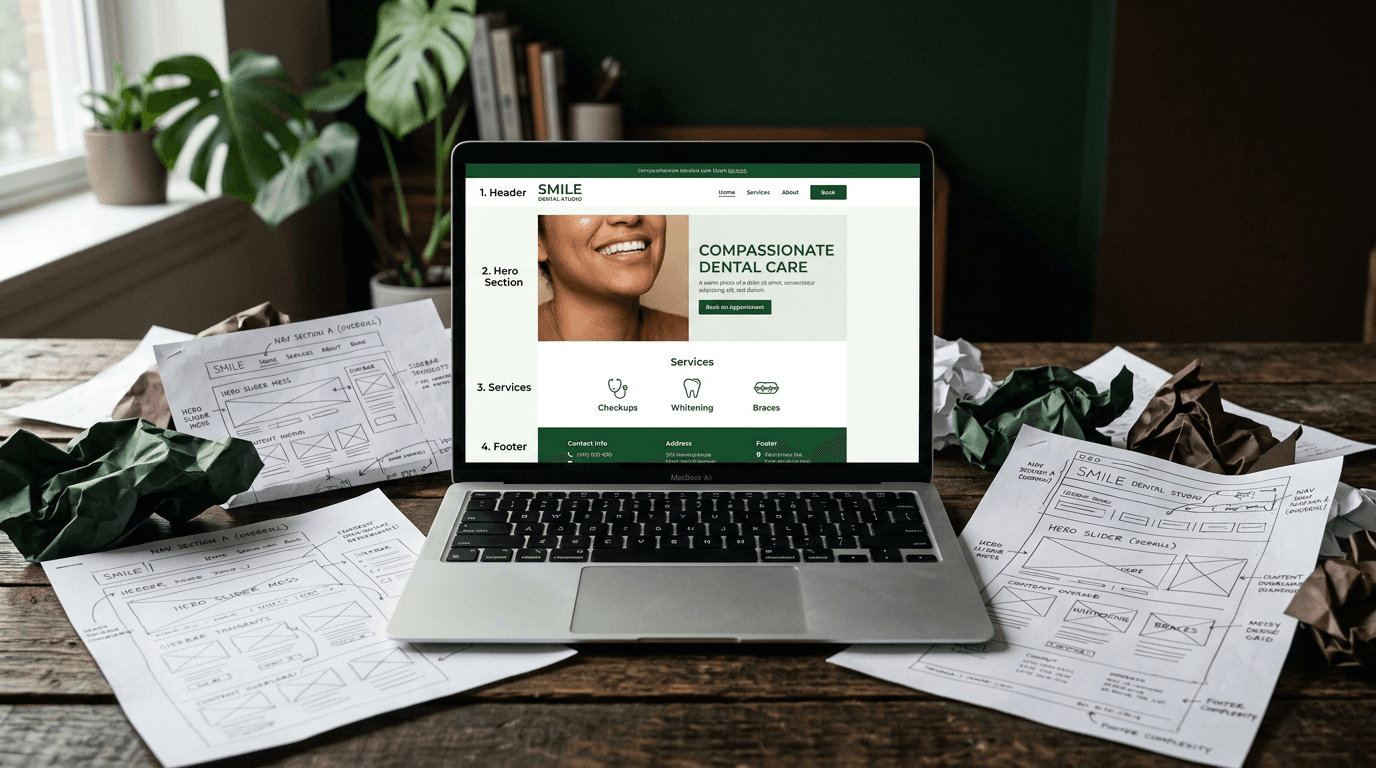
Here are the only pages your dental website needs. I call this the Lean Dental Site Blueprint — a framework that handles everything from patient research to appointment booking without the bloat.
1. Homepage — your 5-second pitch
Purpose: Communicate who you are, where you are, and how to book — immediately.
Your homepage must include practice name, location, and a primary call-to-action above the fold. Add trust signals like a reviews snippet ("4.8 stars from 127 Google reviews") and key credentials. Make it mobile-friendly with a clear "Book Now" button that works on thumb-sized screens.
Skip the stock photos and generic "welcome" copy. Lead with your unique value: "Same-day crowns" or "No-wait emergency appointments" or "Anxiety-free dentistry with sedation options."
2. Services overview — one page, all services
Purpose: Show what you offer without burying visitors three clicks deep.
Structure this as anchor-linked sections or an accordion-style layout. Every major service lives on this single page: general dentistry, cosmetic procedures, orthodontics, emergency care. Use H2 tags for service categories and H3 tags for specific procedures.
Why this beats 12 separate pages: consolidated SEO authority, easier maintenance, better mobile experience. Google understands topical relevance within a page. One well-optimized Services page can rank for "dental implants [city]," "teeth whitening [city]," and "emergency dentist [city]" simultaneously.
3. About / Meet the team
Purpose: Build trust and reduce patient anxiety, especially for new patients and dental-phobic visitors.
Include real photos (not stock), short bios, credentials, and a sentence about your practice philosophy. Keep it to one page unless you have 5+ providers. Patients want to know you're qualified and approachable, not read full CVs.
Focus on what matters to anxious patients: "Dr. Martinez specializes in gentle techniques for nervous patients" beats a paragraph about dental school honors.
4. Testimonials / Reviews
Purpose: Social proof that does the selling for you.
Embed Google reviews or feature 3-5 standout patient quotes. Connect directly to your Google Business Profile for review consistency. Keep HIPAA compliance in mind — use first names only or anonymized quotes unless you have written consent.
Real testimonials with specific outcomes work best: "My crown felt perfect from day one" beats generic "great service" reviews.
5. Contact / Book an appointment
Purpose: This is your conversion page. Everything else funnels here.
Only 26% of dental practices offer online booking — massive competitive advantage for those who do. Include online scheduling integration, click-to-call phone number, address with embedded Google Map, hours, and a simple contact form.
Keep the form short: name, phone, reason for visit. That's it. Every additional field reduces completions.
6. (Optional) Blog / FAQ
Purpose: Answer common patient questions and support SEO for informational queries.
Only add this if you'll actually update it. An abandoned blog with three posts from 2025 hurts more than no blog at all.
Alternative: A single FAQ page answering 10-15 common questions (insurance accepted, first visit process, emergency procedures) is often more effective and far easier to maintain than a blog.
7. (Optional) New patients / Insurance info
Purpose: Reduce phone calls and friction for first-time visitors.
Include accepted insurance list, first visit expectations, and downloadable new patient forms. Only justify as a separate page if this content is substantial. Otherwise, fold it into your Contact page or FAQ section.
The pages you can cut today (and nobody will miss them)
| Page | Why Practices Add It | Why It Fails | What to Do Instead | |------|---------------------|--------------|-------------------| | Individual procedure pages (×12) | "SEO for each keyword" | Thin content, zero traffic, impossible to maintain | Consolidate into one Services page with anchored sections | | Media / Press | "Looks professional" | Nobody visits it; 0 clicks/month | Delete or merge notable mentions into About | | Separate team bio pages | "Personal touch" | Low traffic, stale content | One About/Team page with short bios | | Blog with 3 old posts | "Content marketing" | Signals neglect, dated info hurts trust | Delete or commit to monthly updates | | Gallery / Office tour | "Show off the space" | Slow to load, rarely clicked | Add 2-3 photos to Homepage or About | | Careers page | "We're growing" | Not relevant to patients | Link to job board or add line to About | | Patient portal login | "Convenience" | Better handled by practice software | Link out to portal; don't build into site |
But won't I lose keyword coverage?
Your agency told you each page targets a different keyword. Here's why that logic is outdated.
Google understands topical relevance within a page. One well-structured Services page with proper H2 and H3 tags can rank for multiple procedure-related queries. "Dental implants," "tooth replacement," and "missing teeth solutions" can all rank from the same page section.
Your Google Business Profile categories, patient reviews, and NAP (Name, Address, Phone) consistency matter more for local pack rankings than having a dedicated page for "teeth whitening in [city]."
Exception: If you're in a highly competitive metro AND a specific high-value procedure like dental implants drives significant revenue, one dedicated landing page may be justified. But that's 1 extra page, not 12.
AI-driven search and voice assistants favor concise, well-structured content over sprawling site architectures. When someone asks Siri "find a dentist who does crowns," they want direct answers, not a maze of interconnected procedure pages.
How a simpler site fits your small business reality
You're running a small business, not a media company. Your website should reflect that reality.
Maintenance math: 20 pages × quarterly review = 80 content tasks per year. 6 pages × quarterly review = 24 tasks. Which number actually fits your schedule?
Cost savings are immediate. Fewer pages mean lower design and development costs, whether you're using Squarespace, WordPress, or hiring a developer. A lean site works beautifully on any platform. You don't need a $10,000 custom build for 5-7 pages.
Time to launch shrinks dramatically. A focused site can go live in days, not months. No endless content creation for procedure pages that won't get traffic.
Website performance directly impacts patient acquisition. A fast, simple site that loads in under 3 seconds beats a beautiful site that takes 8 seconds every time.
Your next move
Your patients don't want a magazine. They want to book an appointment. Build your site around that single goal.
First step: Pull up Google Analytics. Find every page with fewer than 10 visits last month. That's your cut list.
Second step: Map your remaining pages to the Lean Dental Site Blueprint above. If a page doesn't match one of the 5-7 core pages, it's a candidate for consolidation or deletion.
The agencies selling you 20-page sites make money on complexity. You make money on appointments booked. What patients actually want from a dentist website is speed, clarity, and easy booking — not an exhaustive digital brochure they'll never read.
Start with the essential pages. Build them well. Watch your appointment bookings increase while your maintenance headaches disappear.
Frequently asked questions
How many pages should a dentist website have? Between 5-7 pages maximum. Homepage, Services, About, Testimonials, Contact are required. Blog/FAQ and New Patient pages are optional if you'll maintain them.
Will fewer pages hurt my SEO rankings? No. Google rewards site quality, speed, and user experience over page count. A lean, fast site often ranks better than a bloated one with thin content.
Can one Services page rank for multiple procedures? Yes. Proper H2/H3 structure and comprehensive content on a single Services page can rank for multiple procedure-related keywords simultaneously.
What if I'm in a competitive market? Focus on Google Business Profile optimization, patient reviews, and site speed. These factors matter more for local dental searches than having dozens of procedure pages.
How do I handle content for specialized procedures? Create detailed sections within your main Services page using anchor links and proper heading tags. Only create separate pages for procedures that drive significant revenue and search volume.