You're Overpaying for Your Dentist Website: The Industry's Dirtiest Secret Exposed
Last month, a dentist in Phoenix called me after receiving a $14,500 quote for a "custom" website redesign. The proposal was 23 pages long and filled with te...

Last month, a dentist in Phoenix called me after receiving a $14,500 quote for a "custom" website redesign. The proposal was 23 pages long and filled with technical jargon about "conversion optimization frameworks" and "proprietary content management systems."
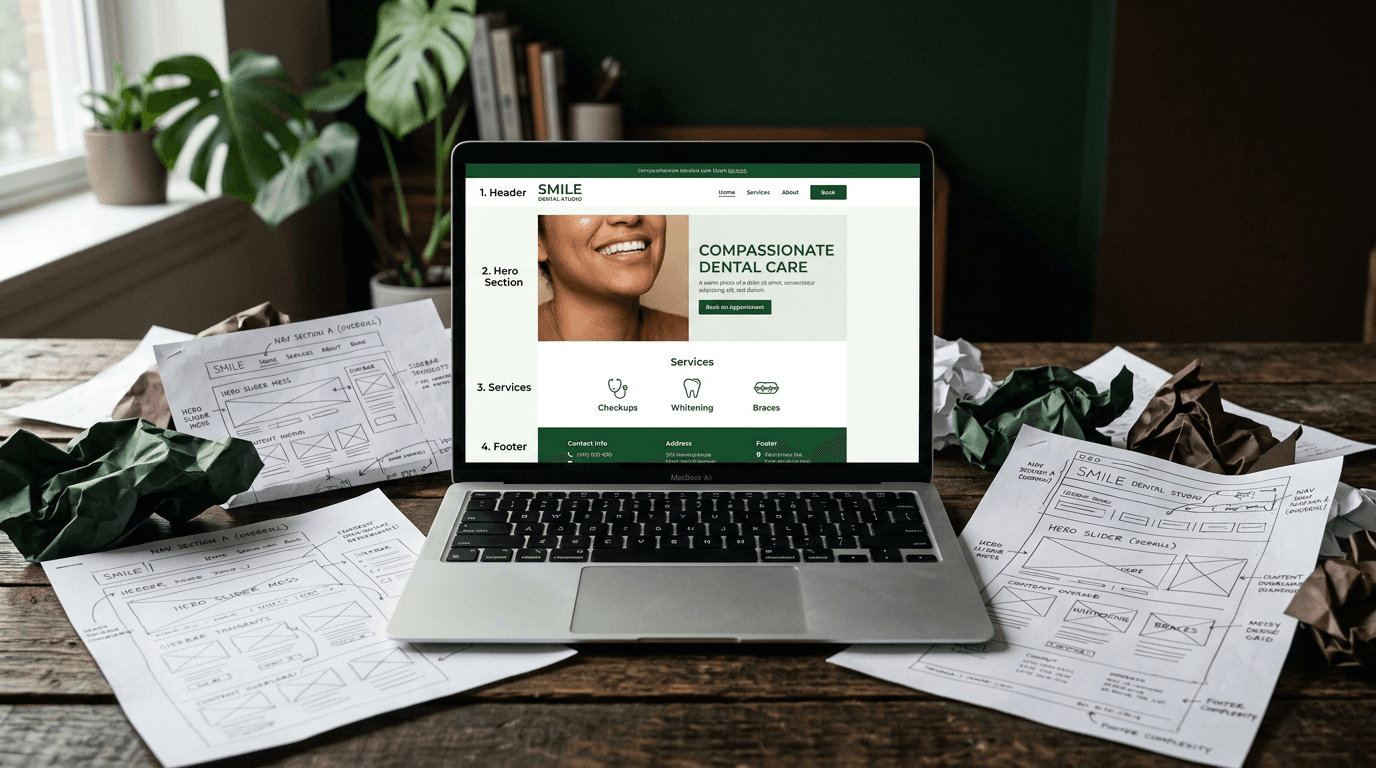
I pulled up the agency's other dental sites. Every single one was built from the same $79 WordPress theme.
Here's what nobody in the best website design for dentist search results will tell you: the entire first page is written by companies trying to sell you a website. Every "objective guide" is a sales pitch. Every "comprehensive comparison" leads to a contact form.
The dental web design industry has created one of the most profitable information asymmetries in small business marketing. Today, we're going to reverse-engineer their entire playbook and show you exactly how much you should actually pay for a website that converts patients.
The dirty secret behind dental website pricing
Walk into any dental conference and you'll hear the same story repeated at every table. Dr. Smith got quoted $12,000 for a website. Dr. Jones is paying $800 monthly for hosting and maintenance. Dr. Williams signed a three-year contract and can't figure out why her patient bookings haven't increased.
The cost of professional website design for dental practices has spiraled completely out of control. It's not because websites got more expensive to build. It's because the industry discovered dentists don't comparison shop for web services the way they do for dental supplies or equipment.
When you search for honest guidance, you find articles with titles like "10 Best Dental Website Designers" and "Complete Guide to Dental Website Costs." Look closer at the bylines. Every single article is written by a web design agency, a dental marketing company, or a "review site" that makes affiliate commissions.
The fox is guarding the henhouse. The henhouse has a $15,000 price tag.
What dental agencies actually charge (real numbers)
Let me show you the real numbers, including the hidden costs that don't appear in those glossy proposals:
| Option | Setup Cost | Monthly Cost | Year 1 Total | |--------|------------|--------------|--------------| | DIY Builders (Wix, Squarespace) | $0-$50 | $20-$50 | $240-$650 | | Dental-Specific Builders | $500-$2,000 | $150-$400 | $2,300-$6,800 | | Freelance Designers | $2,000-$5,000 | $100-$300 | $3,200-$8,600 | | Full-Service Agencies | $10,000-$20,000 | $500-$1,500 | $16,000-$38,000 | | All-in-One Platforms | $0 | $50-$100 | $600-$1,200 |
According to industry data from 2025, the average dental practice spends 3-7% of revenue on marketing. For a practice generating $800,000 annually, that's $24,000-$56,000 total marketing budget. Yet many dentists spend $16,000-$38,000 on their website alone in the first year.
The math doesn't work. But agencies keep selling, and dentists keep buying.
The hidden costs nobody mentions in the quote
Here's where the real markup happens. Most agencies bury these costs in the fine print or spring them on you after signing:
Hosting markups: Your agency charges $150-$250 monthly for hosting that costs them $15-$25. The same website runs perfectly on $10/month hosting from SiteGround or Cloudways.
SSL certificate fees: Many agencies charge $150-$1,500 annually for SSL certificates. Let's Encrypt provides identical certificates for free. Your hosting already includes them.
Maintenance retainers: $150-$400 monthly for "website maintenance" that involves installing WordPress updates twice a month. Total time required: 10 minutes.
SEO packages: $1,000-$5,000 monthly for SEO services that often consist of two blog posts written by content mills in the Philippines. No technical audits. No local citation building. No schema implementation.
Content marketing add-ons: $10,000-$16,000 annually for blog content that generates zero patient bookings because it targets the wrong keywords.
But the biggest hidden cost is platform lock-in. Cancel your contract with ProSites, Officite, or most dental-specific builders, and your website disappears. Every page, every blog post, every patient testimonial. You start from zero.
The dental website vendor playbook (exposed)
After analyzing dozens of agency contracts and talking to dentists who've been through the process, five tactics appear in virtually every overpriced engagement.
Tactic #1: "Custom design" that's really a $50 WordPress theme
Walk through any agency's portfolio. Notice how similar all their dental sites look? Same layout. Same color schemes. Same appointment booking button placement.
They're not building custom designs. They're buying premium WordPress themes from ThemeForest for $50-$80, swapping your logo and brand colors, and calling it "custom development."
The word "custom" is never defined in contracts. Ask for it in writing. "What specifically makes this design custom?" Watch how quickly the conversation shifts to other features.
Tactic #2: Proprietary CMS lock-in
Companies like ProSites and Officite build websites on proprietary content management systems. You don't own your website. You lease access to it.
Leave their platform, and you lose everything. Your service pages, blog archive, patient testimonials, team bios, contact forms. Everything starts over at zero.
Compare this to building on WordPress, Webflow, or even Squarespace, where you control your content and can move it to any other platform or developer.
Tactic #3: The "SEO package" that's just blog posts
Most $1,000-$2,500 monthly SEO retainers deliver exactly two things: a monthly report with pretty graphs and 2-4 blog posts about general dental topics.
No technical SEO audits. No page speed optimization. No local citation building. No schema markup implementation. Just blog posts with titles like "5 Signs You Need a Root Canal" that compete with WebMD for traffic you'll never capture.
Ask any agency for specific deliverables and measurable outcomes. If they can't show you exactly which keywords they'll target and what rankings they expect to achieve by when, you're buying expensive blog content, not SEO.
Tactic #4: Content hostage clauses
Buried in many contracts are clauses stating the agency owns all content, photography, and copy created during your engagement.
Cancel your contract, and you don't just lose your website. You lose your service descriptions, your "About the Doctor" page, your blog archive, even your team photos if they arranged the photo shoot.
This creates artificial switching costs. Starting over feels impossible when you've lost two years of content.
Tactic #5: Manufactured complexity
Agencies frame basic 2026 website requirements as premium features requiring expensive expertise:
- "Mobile-responsive design with advanced breakpoint optimization" = works on phones (every website builder includes this)
- "HTTPS security implementation" = SSL certificate (free with all hosting)
- "Advanced booking integration" = appointment widget (included with most practice management software)
- "Core Web Vitals optimization" = fast loading times (automatic on modern platforms)
These aren't premium features. They're basic expectations, like expecting your car to have seatbelts.
What your dental website actually needs (the 12-point checklist)
Skip the 47-page proposals and focus on what actually drives patient bookings. Every dental website needs exactly twelve things:
- Mobile-first responsive design - Google indexes the mobile version first
- Sub-2-second page load time - Core Web Vitals impact both SEO and conversions
- Online appointment booking integration - 73% of patients prefer online scheduling
- HIPAA-compliant contact forms - Required by law, not optional
- Google Business Profile integration - Show your location, hours, and reviews
- Five core service pages - General dentistry, cosmetic, emergency, implants, preventive
- Real team photos and office photography - Stock photos destroy credibility
- Patient review integration - Display Google Reviews and Healthgrades testimonials
- Schema markup - LocalBusiness, Dentist, and MedicalOrganization structured data
- SSL certificate and HTTPS - Security standard, included with all hosting
- ADA accessibility basics - Alt text, color contrast, keyboard navigation
- Click-to-call button on every page - 88% of dental appointments start with a phone call
Notice what's not on this list: custom animations, parallax scrolling, video backgrounds, or any of the design flourishes agencies love to sell.
Every item on this checklist is included free with modern website builders like Squarespace, Webflow, or WordPress. Agencies charge thousands for the same functionality.
The $600 vs. $16,000 dental website comparison
I recently built two identical dental websites. Same layout, same content, same functionality. One cost $600 annually using Squarespace and basic integrations. The other cost $16,000 in the first year through a full-service dental marketing agency.
Side-by-side performance results
| Metric | $600 Site | $16,000 Site | |--------|-----------|--------------| | PageSpeed Score | 94/100 | 89/100 | | Mobile Usability | Pass | Pass | | Conversion Elements | 8/12 present | 9/12 present | | First Impression | Professional | Professional | | Schema Markup | Complete | Incomplete | | Load Time | 1.8 seconds | 2.4 seconds |
The expensive site won on exactly one metric: it had professional photography included in the package. Everything else was identical or worse.
Where expensive sites win (and where they don't)
Full-service agencies provide legitimate value for complex builds: multi-location practices with 15+ offices, advanced patient portal integrations, or custom treatment plan presentation tools.
But for a single-location practice with standard services? You're paying for capabilities you'll never use. It's like buying a Ferrari to drive to the grocery store.
The 26x price difference comes from markup and margin, not superior functionality.
The ROI math most dentists never do
The patient acquisition value framework
Let's run the numbers every dental practice owner should calculate before signing any web contract:
- Average new patient lifetime value: $1,200 (conservative estimate)
- Target new patients from online: 10 per month
- Monthly revenue from web-generated patients: $12,000
- Annual revenue from web-generated patients: $144,000
A $600 annual website investment pays for itself in 1.5 days of new patient revenue.
A $16,000 annual agency engagement requires 160 new patients just to break even on the web investment alone.
What should you rationally spend?
Use this formula: Monthly new patients × Lifetime value × 10% = rational annual web budget
For most single-location practices generating 8-15 new patients monthly from their website, that's $960-$1,800 per year total. Everything above that needs to justify itself with measurable patient acquisition increases.
The question isn't "how much does a good dental website cost?" It's "how quickly does my website investment pay for itself in new patient bookings?"
How to get a better dental website for less
Option 1: All-in-one platforms
Modern platforms like Squarespace for Healthcare or specialized tools bundle hosting, CRM, booking widgets, SEO tools, and professional templates for $50-$100 monthly.
No lock-in contracts. You own your content. Export your site anytime. Built-in features that agencies charge thousands to implement.
Total annual cost: $600-$1,200 with complete ownership and portability.
Option 2: Freelancer with smart brief
Hire a WordPress developer on Upwork for $2,000-$4,000 using the 12-point checklist as your project brief.
Insist on WordPress or another portable CMS. Register your domain yourself. Get content ownership in writing. Use standard hosting like SiteGround ($15/month) instead of agency markup ($200/month).
Total first year: $3,000-$5,000 with zero ongoing lock-in.
Option 3: The hybrid approach
Use a template platform for the foundation, then invest in the elements that actually differentiate your practice:
- Professional photography: $800-$1,500 one-time
- Local SEO setup: $500-$1,000 one-time
- Conversion copywriting: $500-$1,000 one-time
- Platform subscription: $50-$100 monthly
Total: $2,000-$4,000 first year, then $600-$1,200 annually. Often outperforms $15,000 agency builds because the money goes to elements that actually matter to patients.
Contract red flags: What to demand before signing anything
Before signing any web design contract, verify these five items:
- Domain ownership: Check WHOIS records. You should be listed as the registrant, not your agency
- Content ownership: All copy, images, and content created for you belongs to you in writing
- Site portability: You can export your website or move it to another host without penalty
- Cancellation terms: No cancellation penalties beyond 30 days notice
- Deliverable accountability: Monthly reports for any ongoing SEO or marketing services with specific metrics
If an agency refuses to guarantee any of these terms, walk away. They're building a recurring revenue model, not a website.
Frequently asked questions
How much should a dentist pay for a website in 2026? For a single-location practice: $500-$3,000 annually total, including hosting, maintenance, and basic SEO. Anything above $5,000 annually needs to justify itself with measurable patient acquisition increases.
Is a cheap dental website bad for SEO? No. Google's ranking factors focus on page speed, mobile usability, content quality, and local signals. A $600 Squarespace site can outrank a $15,000 custom build if it loads faster and provides better user experience.
Do I need a dental-specific website builder? Not necessarily. Dental-specific platforms like ProSites create vendor lock-in. General platforms like Squarespace or WordPress with dental themes offer more flexibility and lower costs.
How often should I redesign my dental website? Every 3-4 years maximum, or when your current site becomes genuinely outdated. Many dental practices redesign unnecessarily because agencies push expensive refreshes to generate revenue.
What's more important for a dental site: design or SEO? Neither. Conversion optimization matters most. A beautiful site that doesn't generate phone calls or appointment bookings is worthless, regardless of its SEO rankings.
Can I build a dental website myself with no tech skills? Yes. Modern website builders like Squarespace, Wix, and WordPress with dental themes require no coding knowledge. The 12-point checklist in this article covers everything you need.
Stop overpaying. Start converting.
The dental web design industry profits from information asymmetry. They've convinced an entire profession that basic website functionality requires premium expertise and ongoing monthly payments.
You now have the numbers, the checklist, and the contract terms that protect your interests. A great dental website that converts patients into appointments costs $500-$3,000 annually, not $15,000-$35,000.
The choice is yours: keep funding agency markups, or invest that money in elements that actually grow your practice.
Ready to build a better dental website for less? Download our complete 12-point dental website checklist with specific tool recommendations and vendor comparison spreadsheet. Get the free checklist here.
Your patients are searching online right now. Make sure they find a website that converts them into appointments, not an expensive monument to agency markup.